TSCA Import Certification for Chemicals Shipped from China to the USA
A chemical shipment can meet carrier acceptance requirements and still require a separate TSCA declaration during US customs entry. Classification, approved packaging, an SDS, and dangerous goods transport documents establish how the cargo can move. TSCA import certification addresses the chemical's regulatory status in the United States.
For chemicals shipped from China, the required TSCA filing depends on the chemical identity, intended US use, Inventory status, and any applicable exclusion, exemption, restriction, or EPA order.
TSCA Import Certification for Chemical Shipments
At a Glance: Applicable chemical imports may require a positive TSCA certification, a negative certification, or no certification. Positive certification confirms compliance with applicable TSCA rules and orders. Negative certification applies to chemicals outside TSCA jurisdiction, while certain articles and tobacco products generally require no Section 13 certification.
The Toxic Substances Control Act (TSCA) regulates commercial and industrial chemical substances within its jurisdiction. Section 13 requires the relevant import certification when applicable chemical substances or mixtures are entered through US customs.
The certification functions as a customs declaration. It is separate from an EPA product approval, laboratory test certificate, SDS, or dangerous goods transport declaration.
The importer of record or an authorised agent files the certification with US Customs and Border Protection. Most commercial entries are transmitted electronically through the Automated Commercial Environment (ACE). A paper certification accompanies the entry documents before release.
The current EPA requirements for importing chemicals provide the official positive and negative statements, certifier details, and filing requirements.
Chemical Products Requiring a TSCA Status Review
The chemical identity and intended US use determine which TSCA certification applies. Product categories such as solvent, resin, cleaner, or chemical raw material provide only an initial description.
Products commonly requiring a TSCA status review include:
Industrial solvents and cleaners: The chemical identity and regulatory status of the substances contained in the product determine the certification basis.
Resins and polymers: Importers sourcing liquid resin from China may need to verify an Inventory listing, polymer exemption, inactive designation, or condition under an EPA rule or order.
Adhesives and sealants: Industrial glue and adhesive products can contain several substances with separate Inventory and regulatory records.
Paints, coatings, and printing inks:Paint and coating products and printing inks may contain several substances that need to be reviewed separately.
Lubricants and chemical additives: Composition, concentration, intended use, and regulatory flags can affect which certification applies.
Industrial raw materials and intermediates: Liquids, powders, pastes, and blends may fall within TSCA across dangerous and non-dangerous transport classifications.
A formulated mixture is generally assessed through its relevant component substances. The same trade name can remain in use after an ingredient, concentration, manufacturer, or source material changes. The earlier TSCA basis may no longer correspond to the revised formulation.
A polymer or resin can be listed on the Inventory or covered by an applicable exemption. General product descriptions do not identify the specific regulatory basis.
Products governed under other federal statutes may fall outside TSCA jurisdiction. Common examples include pesticides, food and food additives, drugs, cosmetics, certain medical devices, nuclear materials, firearms, and ammunition.
Chemicals forming part of an article (In this context, an article is a finished item whose shape or design determines its function, such as a component or manufactured product, rather than a chemical supplied as a liquid, powder, or mixture)
Whether this rule applies depends on the product form, the function of the chemical within the finished item, and any product-specific TSCA programme.
TSCA Inventory Checks for Chemical Substances
The EPA TSCA Chemical Substance Inventory is the main public reference for establishing whether a substance is treated as an existing chemical. The current public files can be searched by CAS Registry Number or chemical name through EPA's TSCA Inventory resources.
The CAS number normally comes from the manufacturer's technical information or Section 3 of the SDS. A mixture may require separate searches for several component substances because the commercial product name does not establish the status of each component.
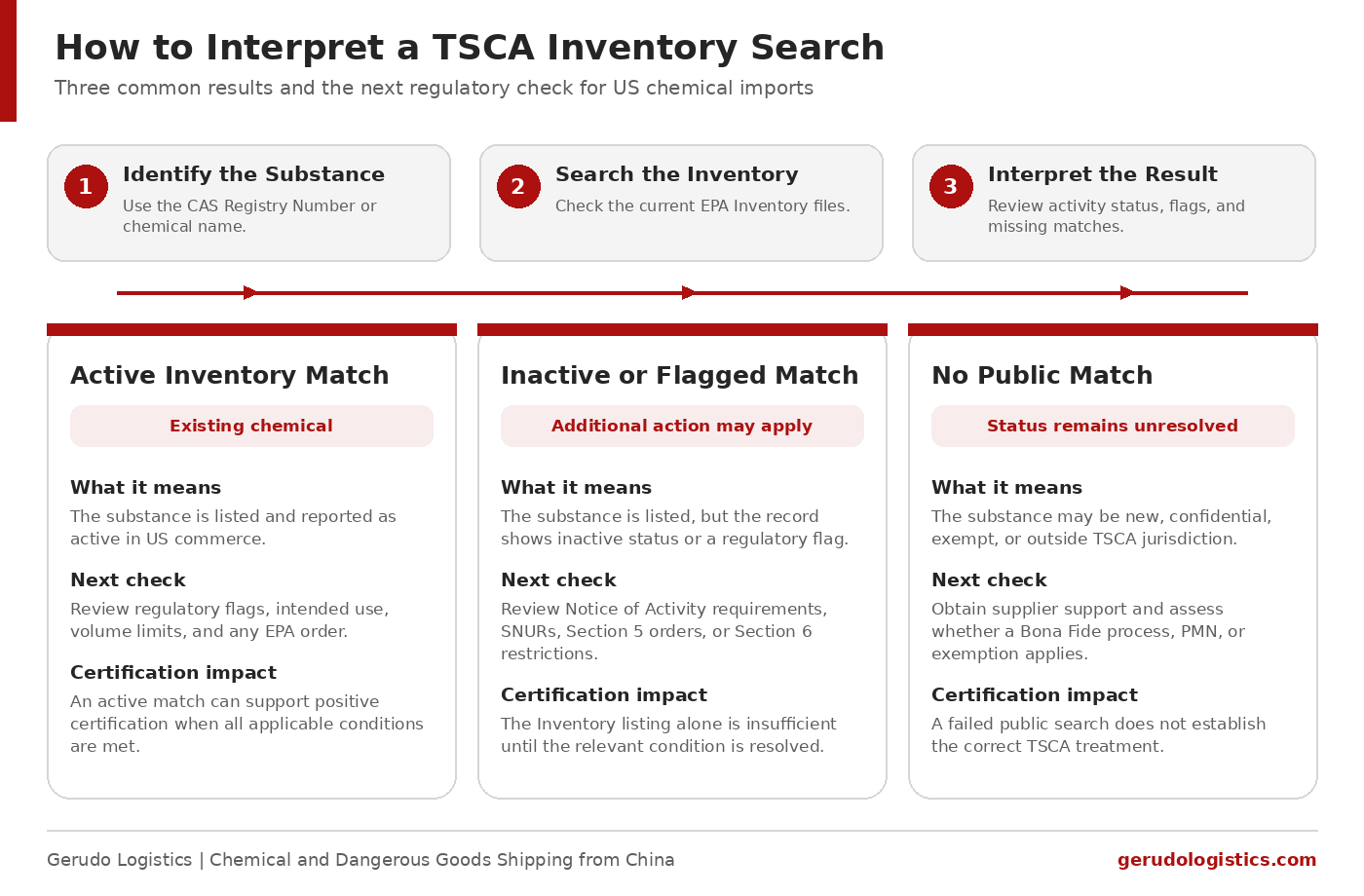
The Substance Appears as Active
An active Inventory listing confirms that the substance is treated as an existing chemical and has been reported as active in US commerce for the relevant reporting period.
The result can also contain regulatory flags linked to a Significant New Use Rule (SNUR), Section 5 order, test rule, restriction, or another condition. A SNUR is a rule that can require advance notice before an existing chemical is used in a newly designated way. The underlying rule determines how the flag affects the planned US activity.
A matching CAS number can therefore coexist with a use restriction, volume condition, worker-protection requirement, labelling condition, or advance notification obligation. If the listing is active and no relevant flag applies, keep the Inventory evidence and confirm that the product composition matches the shipment.
The Substance Appears as Inactive or Flagged
An inactive designation means the substance remains on the Inventory, although it has not been reported as active for the relevant period. Reintroduction into US commerce may require a Notice of Activity Form B before the activity begins.
A regulatory flag indicates that an additional rule, order, or restriction may apply. The status review needs to connect the flagged requirement with the intended use, quantity, manufacturing process, and other relevant conditions.
An inactive or flagged result does not automatically prevent the shipment. It means the Inventory listing alone is insufficient to support the certification decision. Do not select the certification based on the Inventory match alone. Ask the customs broker or compliance adviser to review the linked rule before the filing is finalised.
No Public Inventory Match Is Found
The absence of a public match has several possible explanations:
New chemical substance: The substance may not yet be listed as an existing chemical.
Confidential chemical identity: The specific identity may be protected as confidential business information and may appear under a generic name or accession number.
Applicable exemption: The substance may qualify under an exemption that is not established through a standard public search.
Outside TSCA jurisdiction: The product may be governed under another federal statute.
EPA's Bona Fide process is used to ask EPA whether a substance is already listed on the confidential Inventory when public information is insufficient. Supplier support may be required when the full identity is withheld from the importer.
A genuinely new chemical substance intended for non-exempt commercial import may require a Premanufacture Notice (PMN), which is a pre-import notice filed at least 90 days before the first import.
An existing substance can also require advance notice when the intended activity qualifies as a significant new use. Before finalising the customs filing, request additional chemical identity, exemption, or EPA status support from the manufacturer.
How to Fill Out the TSCA Import Certification
There is no single EPA paper form used for every chemical shipment. Most commercial certifications are transmitted through ACE by the importer or its customs broker.
A broker or freight forwarder may provide a declaration template to collect the required information. The template supports the customs filing and does not replace the final compliance decision.
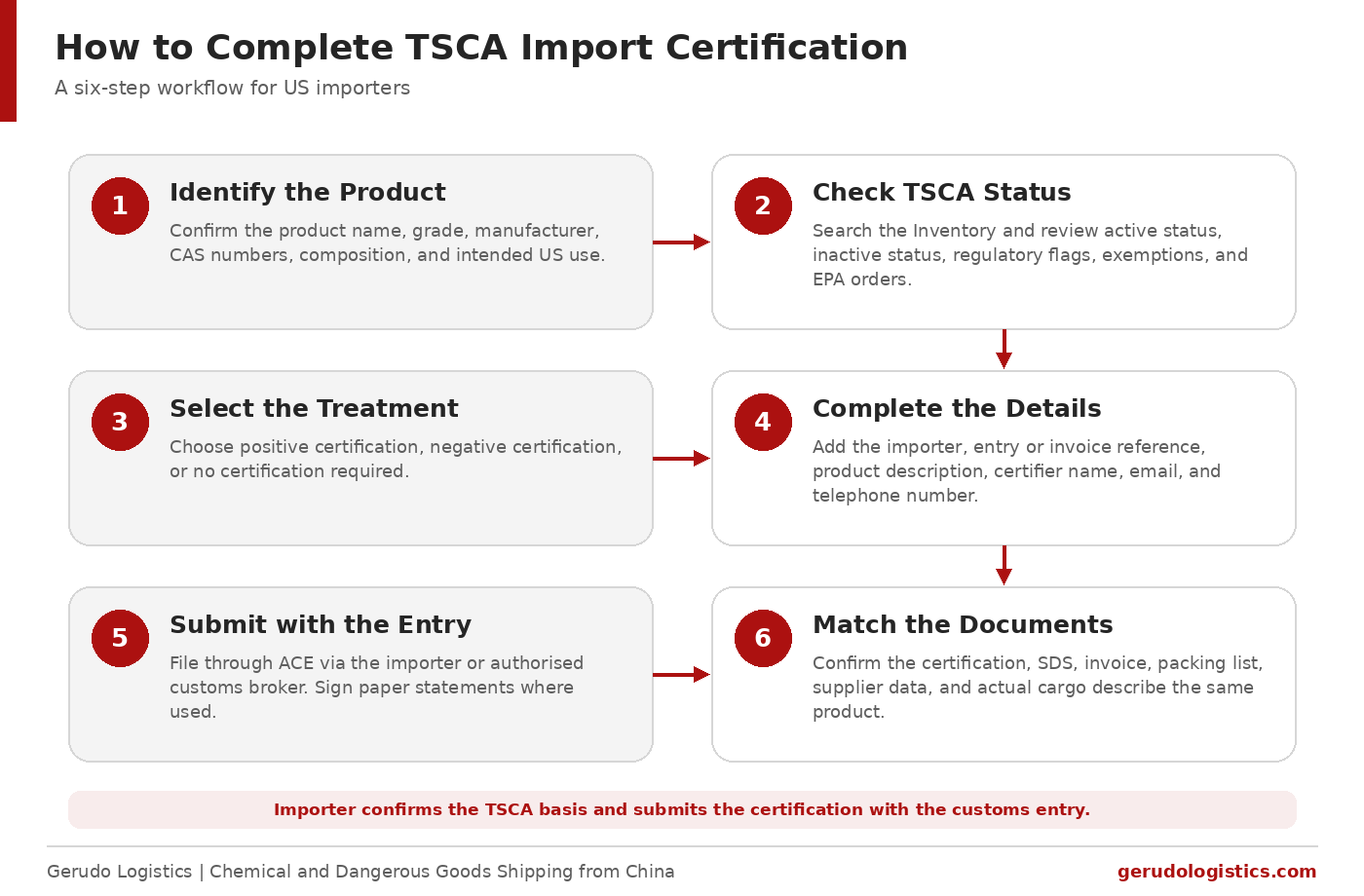
Step 1 Identify the Product and Chemical Substances
The review begins with the exact product supplied for the shipment.
The available information needs to establish:
Commercial product name and grade: These details connect the technical information with the invoice and packing list.
Manufacturer: Products sold under the same trade name can differ when they come from different manufacturing sources.
Chemical names and CAS numbers: These details support the Inventory search and regulatory review.
Composition: A mixture may contain several relevant substances with separate TSCA records.
Intended US use: Specific rules, orders, and exemptions can depend on how the substance will be processed or used.
The manufacturer or supplier in China normally provides the SDS, composition information, technical data, and supporting declarations used for this step.
Step 2 Check the Inventory and Regulatory Status
Each relevant substance is checked against the current TSCA Inventory using its CAS number or chemical name.
The result needs to establish whether the substance is:
Listed as active
Listed as inactive
Subject to a regulatory flag
Absent from the public Inventory
Covered by a confidential identity
Supported by an applicable exemption or EPA determination
A positive certification cannot be based solely on finding the CAS number in the Inventory. Any active status, restriction, order, or use condition attached to the substance also forms part of the review.
Step 3 Select the Certification Treatment
The customs entry can require positive certification, negative certification, or no certification.
Positive certification: This applies when the chemicals fall within TSCA jurisdiction and comply with all applicable TSCA rules and orders.
Negative certification: This applies when all chemicals covered by the declaration are outside TSCA jurisdiction and the customs entry requires confirmation of that status.
No certification required: This generally applies to chemicals forming part of an article, unless a specific TSCA rule requires certification, and to tobacco products.
Descriptions such as non-toxic, non-hazardous, food grade, pharmaceutical grade, or environmentally friendly do not determine the certification treatment.
For a chemical mixture, the importer must check the relevant component substances before selecting the certification. A valid status for one component does not establish the status of the complete formulation.
Step 4 Complete the Certification Details
The certification identifies the responsible certifier and the relevant customs entry.
The information normally includes:
Importer of record
Invoice or shipment reference
Product description
Selected certification treatment
Certifier's full name
Email address
Telephone number
A paper filing also requires the certifier's signature. The current EPA certification wording needs to be used without changing the substance of the statement.
The official positive statement confirms compliance with all applicable TSCA rules and orders. The negative statement confirms that all chemicals covered by the declaration are outside TSCA jurisdiction.
Step 5 Submit the Certification with the Customs Entry
The US importer of record remains responsible for the certification. An authorised customs broker can prepare and transmit the electronic filing through ACE.
A paper certification must accompany the entry documents before release. It can be included on the commercial invoice or provided as a separate signed statement connected to the correct entry.
The freight forwarder can provide a template, collect supporting documents, and coordinate information among the manufacturer, importer, and customs broker. Regulatory responsibility remains with the importer or its authorised representative.
Step 6 Confirm the Documents Match the Shipment
The certification needs to correspond to the actual product presented for customs clearance.
The following details should align across the available documents:
Commercial product name
Manufacturer
Product grade
Chemical identity
CAS number
Composition
Quantity
Intended use
Applicable certification treatment
A previous TSCA review may no longer support the shipment after a change in formulation, manufacturer, product grade, chemical source, intended use, or an exemption condition.
Documents Required Before Shipping Chemicals to the USA
The required documents depend on the product composition, intended use, transport classification, TSCA status, packaging, and customs entry requirements.
Chemical identity documents: The commercial product name, chemical names, CAS numbers, composition, manufacturer, and intended US use identify the substances covered by the certification.
SDS: The SDS for dangerous goods shipping from China supports product identification, hazard review, handling, and transport classification. Additional manufacturer information may be necessary where the SDS uses broad descriptions or confidential ingredients.
TSCA supporting documents: Inventory results, activity status, regulatory flags, exemption records, EPA determinations, and manufacturer declarations support the selected certification treatment.
Dangerous goods transport documents: Where the cargo is regulated as dangerous goods, the documents may include the UN number, Proper Shipping Name, hazard class, packing group, package specification, and quantities.
Dangerous Goods Declaration: A Dangerous Goods Declaration applies when the selected mode and transport regulations require it. It is not mandatory for every chemical shipment.
Customs entry documents: The importer of record, customs broker, HTS classification, manufacturer, seller, country of origin, invoice description, quantity, and TSCA certification connect the technical product information to the US entry.
Importers handling liquid products can also review our guide to shipping liquid chemicals from China to the USA for packaging, transport options, carrier requirements, and US delivery planning.
Common TSCA Issues During US Chemical Import Clearance
TSCA clearance problems usually involve the status of the substance, an incomplete certification, or inconsistencies between the declaration and the cargo.
New Chemical Status Is Unresolved
A substance absent from the public Inventory may be new, confidential, exempt, or outside TSCA jurisdiction.
A genuinely new substance intended for non-exempt commercial use may require a PMN at least 90 days before import. A public search can also be inconclusive when the identity is confidential.
A Bona Fide Notice supported by supplier information may be required for an authoritative EPA status determination.
Existing Chemical Requirements Are Not Met
An Inventory-listed substance may remain subject to inactive status, a Section 5 order, a Significant New Use Rule, a Section 6 restriction, or another regulatory condition.
The rule behind the Inventory flag determines whether the proposed US activity meets the relevant conditions. A Significant New Use Rule can require advance notice before the designated new use begins.
Finding the correct CAS number on the Inventory establishes only one part of the certification basis.
Certification Information Is Unsigned or Incomplete
A paper certification needs the required certifier information, certification statement, and signature.
Common defects include missing contact details, no certification selection, altered wording, or a declaration linked to the wrong entry.
Under the federal TSCA chemical import policy, CBP can withhold release while the required certification is missing. Detention or refusal can also occur where the chemical or its entry does not comply with TSCA.
Certification Documents Do Not Match the Cargo
The TSCA supporting documents need to correspond to the product presented for customs clearance.
Discrepancies can arise when:
The CAS number differs: The declaration, SDS, and manufacturer information identify different substances.
The wrong product grade is used: The documents describe a similar formulation instead of the shipped grade.
The formulation has changed: A revised mixture contains a component absent from the earlier review.
The manufacturer has changed: The same trade name is used for a product from a different source.
The intended use has changed: The planned US activity can trigger a restriction or Significant New Use Rule that was not part of the earlier assessment.
An exemption condition is exceeded: The quantity, use, manufacturing process, or another condition falls outside the terms of the claimed exemption.
Outdated technical documents create the same risk. The document date is less important than whether the information accurately describes the product presented for entry.
Shipping Chemicals from China to the USA with Gerudo Logistics
Gerudo Logistics manages chemical and dangerous goods shipments from China through air, sea, road, and multimodal transport. We coordinate classification review, compliant packing, carrier acceptance, customs documentation, and final delivery for cargo in drums, IBCs, ISO tanks, cylinders, cartons, and other approved packaging formats.
For US-bound chemical cargo, our team aligns the SDS, product information, packaging details, transport documents, and customs information before booking.
We can also coordinate TSCA-related documents with the importer and customs broker while the final compliance decision remains with the responsible US party. Contact us to discuss your chemical shipment from China.
TSCA Import Certification FAQs
Does Every US Customs Entry Need a New TSCA Certification?
TSCA certification is connected to the customs entry. An earlier product review may support repeat shipments where the composition, manufacturer, intended use, and regulatory status remain unchanged, while each applicable entry still requires the relevant certification.
Can One TSCA Certification Cover Multiple Products on the Same Invoice?
One statement may cover several entry lines where the same certification treatment applies to all included chemicals. Products requiring different treatments need to be identified correctly in the customs filing.
Can a TSCA Certification Cover a Chemical Mixture?
Yes. A shipment-level certification can cover a mixture, provided that the compliance basis accounts for the relevant component substances.
What Happens If the CAS Number Is Missing from the SDS?
A separate manufacturer statement or composition document may be needed to establish the chemical identity. Confidential identities may require supporting information to be provided directly to an authorised party.
Can a Trade Name Be Used for TSCA Certification?
A trade name can appear in commercial and customs documents. The supporting information still needs to connect the product with its chemical identity and TSCA status.
Can the Same TSCA Review Be Used After Changing Suppliers?
A supplier change can affect the manufacturer, formulation, chemical source, or confidential composition. The revised product information needs to support the certification used for the new shipment.
Can a Freight Forwarder Submit the TSCA Certification?
A freight forwarder can provide a template and coordinate documents. The importer of record or its authorised customs agent remains responsible for the certification filed with US customs.
Conclusion
TSCA import certification depends on the chemical identity, intended use, and regulatory status of the product entering the United States. Inventory listing alone may be insufficient where the substance is inactive, confidential, restricted, new, or subject to a specific EPA condition.
Clear manufacturer information and consistent customs and transport documents reduce the risk of a certification error becoming a clearance problem after arrival.