Importing Smart Pet Products from China to the USA
An automatic litter box and a GPS collar may sit in the same smart pet product catalogue, yet they create very different freight problems. The litter box can be driven by carton volume, while the GPS collar may involve lithium battery and wireless-device checks before it moves.
For USA importers sourcing smart pet devices from China, these differences affect freight cost, shipping time, carrier acceptance, customs classification and product compliance. This guide explains how to plan the shipment and prepare smart pet products for entry into the USA.
Smart Pet Products Commonly Imported from China
China supplies smart pet devices ranging from large automated appliances to compact connected electronics. Their power source and physical size give importers an early indication of how the cargo may need to move.
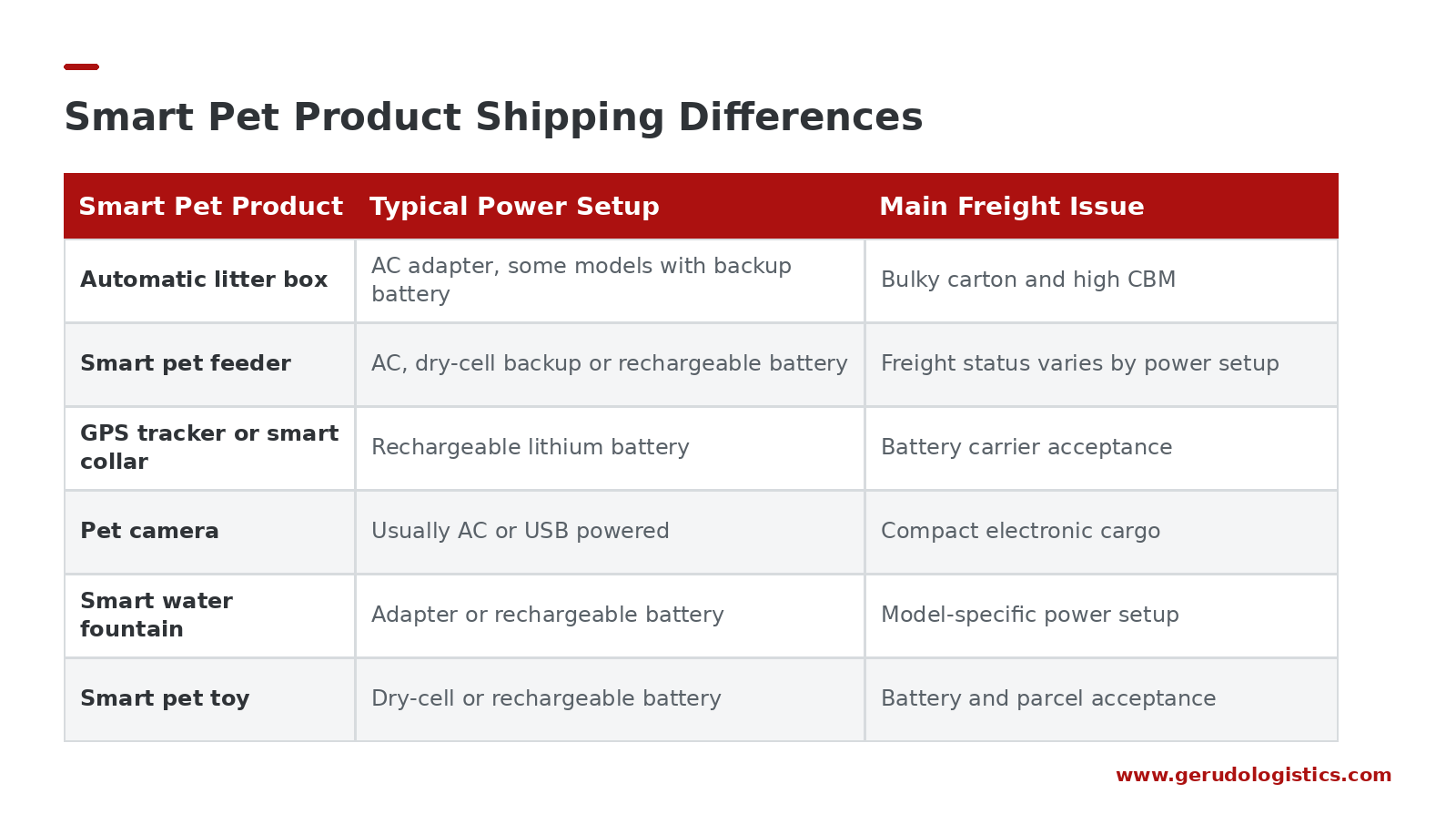
A smart feeder shows why the final configuration matters. One model may use an AC adapter with AA batteries for backup, while another contains a rechargeable lithium battery. That difference can change the freight preparation even when the products look almost identical.
Shipping Smart Pet Products from China to the USA
Freight planning depends on the packed cargo, especially carton dimensions, shipment quantity, battery status and required delivery date.
Compact trackers and large automatic pet appliances can have very different freight economics, even when both are sold under the same smart pet category.
What Determines Smart Pet Product Shipping Costs?
The main cost driver depends on the type of product.
Bulky appliances: Automatic litter boxes and some large feeders can create high dimensional weight for express or air freight and high CBM for ocean freight.
Compact connected devices: GPS trackers, collars and small cameras occupy much less space, making express or air freight more practical for smaller commercial orders. Rechargeable batteries can add carrier acceptance requirements.
Mid-size devices: Feeders and fountains often sit between these two profiles. Carton dimensions, order quantity and power configuration determine whether air or ocean freight gives the better result.
A useful freight quote needs the final carton dimensions, gross weight, quantity, total CBM, pickup location and USA destination. Unit weight alone is rarely enough for this product category.
Importers should also compare the landed logistics impact rather than focusing only on factory unit price. A low-priced bulky appliance can cost more to move per unit than a smaller connected device with a higher purchase price.
How Long Do Smart Pet Products Take to Reach the USA?
Shipping time depends mainly on the freight method and whether the cargo is fully ready for carrier acceptance.
Express: Compact devices can often reach the USA within roughly 3 to 7 days after pickup and acceptance.
Air freight: Commercial air shipments commonly require around 7 to 14 days door-to-door once the cargo is ready.
Ocean freight: Larger commercial shipments normally require several weeks. The exact time varies by origin port, USA destination, carrier schedule and service.
Battery acceptance can add preparation time before departure for rechargeable products. Orders collected from several suppliers may also need additional time in China before the international movement begins.
Current route-level schedules and port options are covered in the China to USA shipping guide, which is more suitable for checking general route transit times than a product-specific guide.
Choosing Express Air Freight LCL or FCL
The product profile usually narrows the practical freight options quickly.
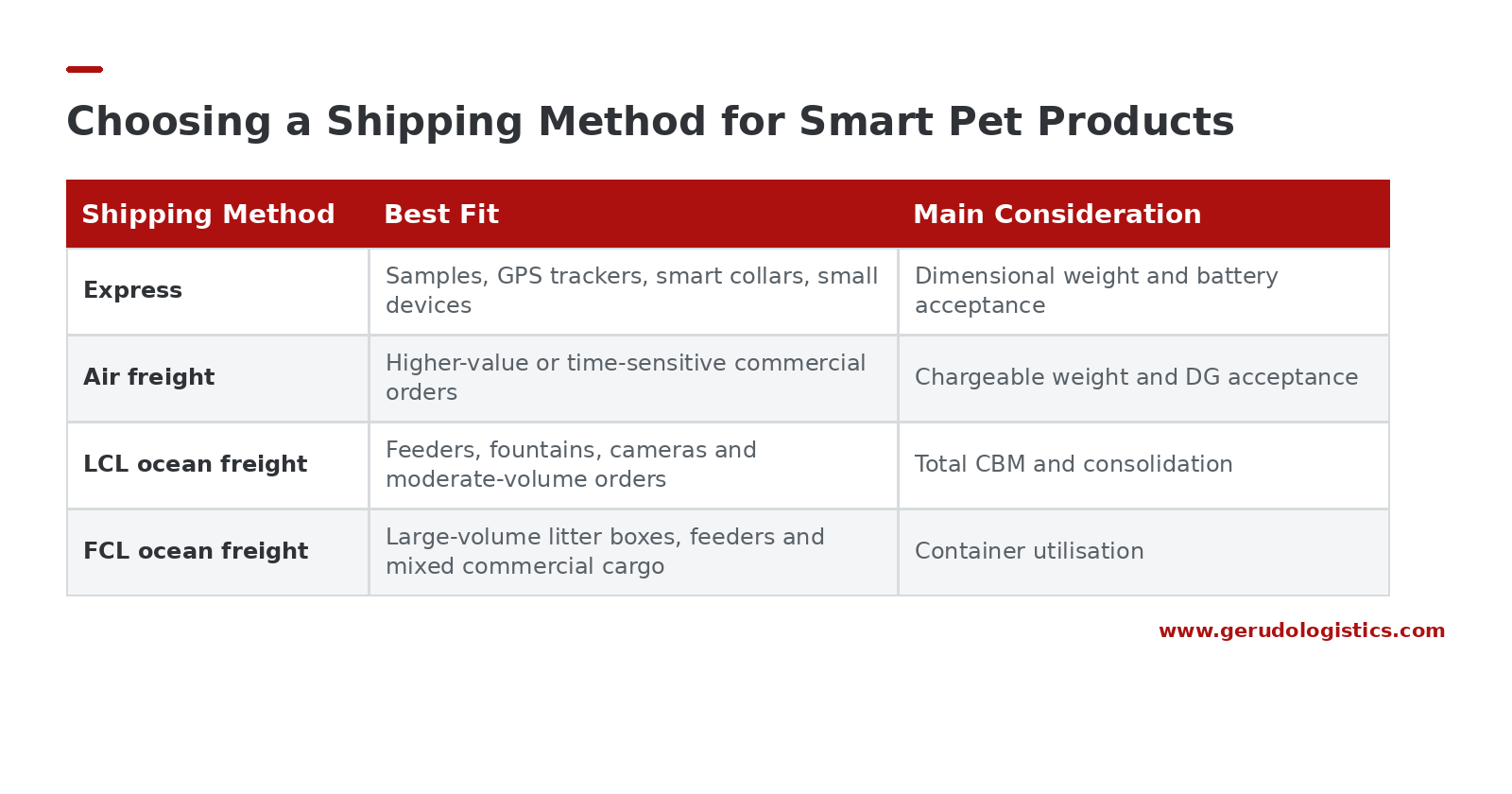
Express shipping works well for samples, smaller orders and compact devices where speed matters. Rechargeable products still need to meet the selected courier's battery acceptance conditions.
Air freight becomes more relevant when the shipment is larger than a normal courier order while inventory timing remains important. Compact, higher-value connected products are more likely to justify the additional freight cost.
LCL ocean freight suits many commercial shipments of feeders, fountains, cameras and other smart pet devices when a full container is unnecessary. Products collected from several suppliers can also be consolidated once their freight status is clear.
FCL ocean freight becomes more attractive as total CBM grows and container utilisation improves. Importers of bulky automated pet appliances should therefore monitor occupied container space rather than relying on a fixed weight threshold.
Lithium Batteries in Smart Pet Products
GPS trackers, rechargeable smart collars and many portable smart toys commonly use lithium-ion batteries. Feeders, fountains, cameras and automated appliances can use AC power, replaceable batteries or rechargeable systems depending on the model.
The main transport question is how the battery is supplied with the device.
How the Battery Is Packed Changes the Shipment
A lithium-ion battery installed inside a GPS tracker has a different transport configuration from a spare battery supplied separately. A removable rechargeable pack can also require different preparation from an otherwise similar AC-powered device.
For battery-powered products, confirm whether the battery is installed in the equipment, packed with the equipment or supplied separately before the freight method is finalised.
This configuration affects the applicable dangerous goods provisions and can also affect carrier acceptance, particularly for air transport.
Battery Information to Verify Before Shipping
For a rechargeable smart pet device, the key information normally includes:
Battery chemistry
Battery manufacturer and model
Nominal voltage
Rated capacity and Watt-hour rating
Number of batteries in the product
Battery installation or packing configuration
UN38.3 test summary
The UN38.3 test summary should correspond to the battery being supplied. A change in battery supplier, cell type or pack design can mean the existing transport documentation needs to be checked again.
The wider requirements for lithium cells and battery-powered equipment are covered separately in the guide to shipping battery-powered products from China.
US Requirements for Imported Smart Pet Products
The main USA import checks for connected pet devices involve wireless functions, customs classification, origin marking and applicable consumer product rules.
FCC Requirements for Connected Pet Products
Pet cameras, connected feeders, GPS trackers, smart collars and some app-controlled appliances use Wi-Fi, Bluetooth, cellular or other radio-frequency functions.
Applicable devices need to meet FCC equipment authorization requirements before import and marketing in the USA. The importer should confirm that the available authorization covers the wireless version being purchased.
Useful checks include the applicable FCC ID or authorization record, the wireless functions covered by it, the radio module used in the product and any hardware or module changes made after authorization.
A manufacturer may offer wired, Bluetooth, Wi-Fi and cellular versions of the same basic device, so the authorization information needs to correspond to the version entering the USA.
HTS Codes for Different Smart Pet Products
Smart pet products can fall under very different HTS classifications according to how they function.
For example, CBP has classified a smart pet fountain under HTSUS 8413.70.2004 based on its pump function. A self-cleaning electric litter box has also been classified under heading 8509 for electromechanical domestic appliances.
These are useful classification examples rather than default codes for every fountain or litter box. A different motor, pump, communication function or product design can lead to another classification.
If a supplier's proposed code is uncertain, the HS and HTS code verification guide explains how to check the classification before entry. Once the code is confirmed, current duty treatment can be checked in the US tariff guide for imports from China.
Other US Import Requirements
China-made smart pet products generally need the applicable country-of-origin marking before entering the USA. Product and packaging artwork should be checked while the goods are still in China.
CPSC requirements depend on the particular product. From July 8, 2026, imported consumer products already subject to a CPSC certification requirement must have the required certificate data filed electronically.
The official CPSC eFiling guidance explains the current requirement. Importers first need to determine whether the specific product is subject to a CPSC rule that requires certification.
Chinese Smart Pet Brands and Sourcing Options
China's smart pet supply chain includes established brands as well as manufacturers producing OEM and private-label products. The sourcing route affects how much control the importer has over the final product and which decisions remain with the buyer.
Established Chinese Smart Pet Brands
PETKIT and CATLINK are examples of China-based brands selling connected litter boxes, feeders, fountains and other smart pet devices in international markets.
Importing an established brand can involve distribution rights, warranty arrangements, replacement parts and app support. These commercial conditions matter because connected pet products often depend on software and after-sales support in addition to the physical device.
OEM and Private-Label Products
An OEM or private-label product gives the buyer more control over areas such as the battery, wireless module, housing, packaging and branding.
These choices can also affect the shipment. Changing a rechargeable battery can affect battery documentation, while changing a wireless module can alter the FCC information that needs to be verified. Larger retail packaging can also increase air chargeable weight or ocean CBM.
The final production configuration should therefore be settled before the freight plan and USA import requirements are confirmed.
Key Checkpoints from China to the USA
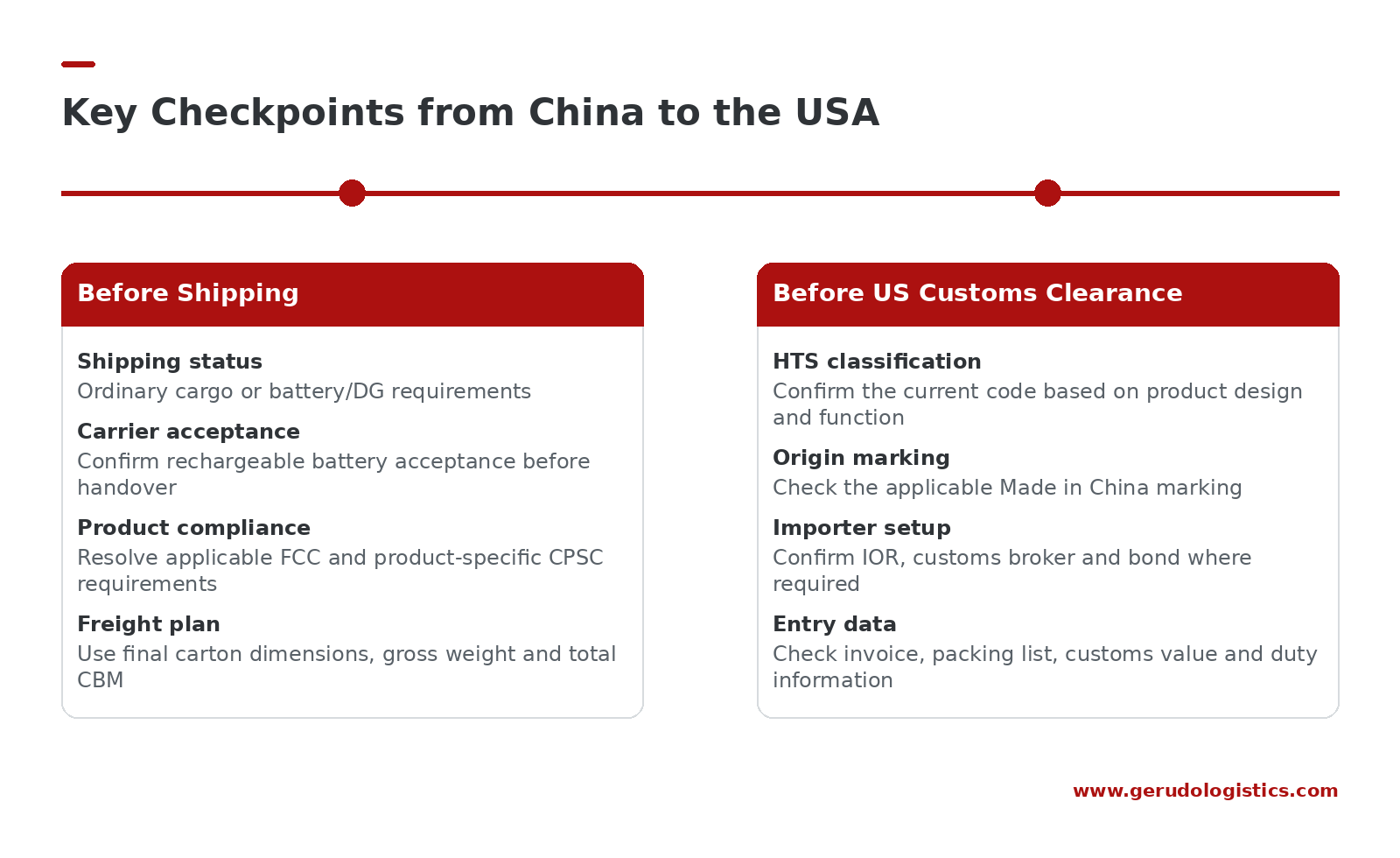
Two stages deserve particular attention: before the shipment leaves China and before the USA customs entry is completed.
Before Shipping
Shipping status: Confirm whether the product moves as ordinary cargo or under battery/DG requirements.
Carrier acceptance: Confirm acceptance for rechargeable battery configurations before cargo handover.
Product compliance: Resolve applicable FCC and product-specific CPSC requirements.
Freight plan: Confirm the shipping method using final carton dimensions, gross weight and total CBM.
Before US Customs Clearance
HTS classification: Confirm the current HTS code based on the product's design and function.
Origin marking: Check the applicable Made in China or other country-of-origin marking.
Importer setup: Confirm the Importer of Record, customs broker and customs bond where required.
Entry data: Check the commercial invoice, packing list, customs value, product description and duty information.
The party acting as the Importer of Record for a China to USA shipment remains responsible for key entry information even when a customs broker handles the filing.
For ocean freight, applicable ISF information also needs to be ready within the required filing timeline.
Smart Pet Product Import and Shipping Support from China
Gerudo Logistics arranges smart pet product shipments from China by express, air freight, LCL, FCL and door-to-door services. Freight planning is based on the product configuration, cargo volume, destination and required delivery schedule.
As a dangerous goods specialist, Gerudo Logistics can coordinate smart pet devices containing regulated batteries as well as ordinary electronic products and supplier consolidation where required. Operations across Guangzhou, Shenzhen, Shanghai, Ningbo, Qingdao and Dalian support USA-bound shipments from China.
Contact us to review the shipping requirements for your smart pet products from China.
Frequently Asked Questions
How much does it cost to ship automatic litter boxes from China to the USA?
Automatic litter box freight depends heavily on carton dimensions and total CBM. A reliable comparison requires the packed dimensions, quantity, gross weight, China pickup point and USA destination before air, LCL and FCL costs can be compared.
How long does it take to ship smart pet products from China to the USA?
Express shipments can often arrive within roughly 3 to 7 days, while commercial air freight commonly takes around 7 to 14 days door-to-door once the cargo is ready. Ocean freight normally requires several weeks, depending on the route and service.
Is air or sea freight better for smart pet products?
Air is more practical for compact, higher-value or time-sensitive devices. Ocean freight generally suits larger commercial quantities, high-CBM appliances and orders where freight cost matters more than speed.
Can smart pet products with lithium batteries ship by air?
Many battery-powered smart pet devices can move by air when the battery configuration, documentation and carrier acceptance meet the applicable requirements. The shipping treatment depends partly on how the battery is supplied with the equipment.
Do Wi-Fi and Bluetooth pet products need FCC authorization in the USA?
Applicable radio-frequency devices need to meet FCC equipment authorization requirements before import and marketing in the USA. The authorization should cover the wireless configuration being purchased.
Do all smart pet products use the same HTS code?
No. Classification follows the actual function and construction of the product, so a pet fountain, tracker, camera and automatic litter box can fall under different HTS headings.
Should I import an established Chinese smart pet brand or use private label?
Established brands can provide an existing product ecosystem, distribution structure and after-sales support. Private label provides more control over the product, while the importer needs greater oversight of the final battery, wireless, marking and packaging configuration.