Lithium Battery Data Loggers in Air Freight: When the IATA Exception Applies
A shipment of vaccines, medical reagents or precision electronics is packed and ready to leave China. A small battery-powered logger is already inside the package, recording the conditions around the cargo. If its transport status has not been confirmed, that device can trigger new document or airline acceptance questions after the shipment reaches the airport.
A data logger is a small electronic device that records temperature, humidity, shock or location during transport. Importers use these devices with pharmaceuticals, perishable food, electronics, artwork and other condition-sensitive cargo.
The installed lithium battery gives the logger its own air transport status, which this guide explains under the 67th Edition of the IATA Dangerous Goods Regulations, effective from 1 January 2026.
Data Logger Roles in Air Freight
The first distinction is the device's role in the current shipment. A logger monitoring another consignment and a carton of new loggers purchased as products follow different air freight requirements, even when they contain the same battery.
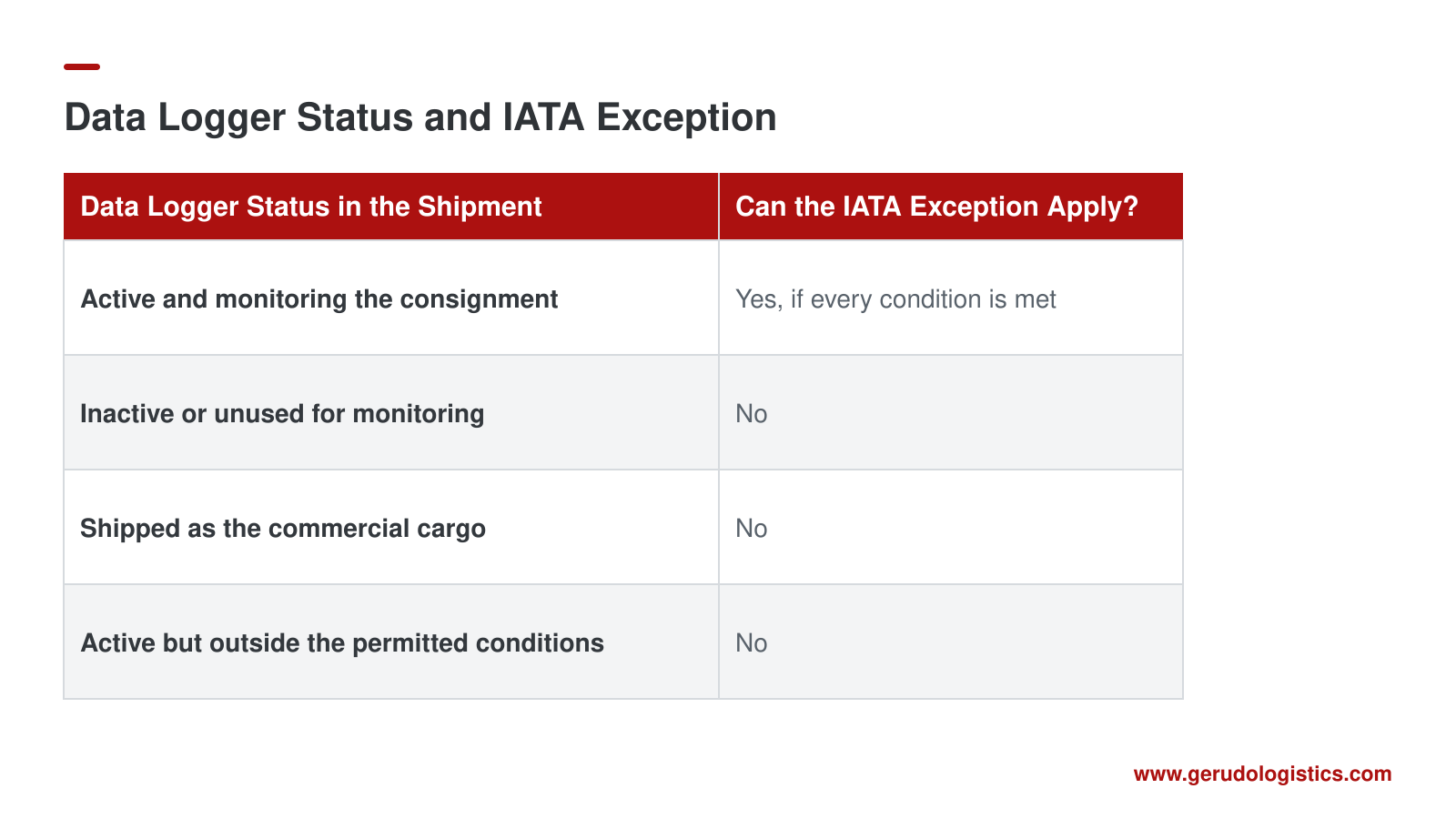
In this context, active means that the device is operating or intended to operate during transport for the specific consignment. The transport function establishes this status; the switch position alone is insufficient.
A temperature logger inside an insulated box of medical reagents may qualify as a monitoring device. The same model packed in a carton for sale is battery-powered equipment being transported as cargo.
This distinction also applies to cargo tracking devices attached to a package, overpack or unit load device. A tracker can monitor location or handling conditions, while a conventional logger may store temperature data for retrieval after arrival. Both can fall within the same IATA exception when every applicable condition is satisfied.
IATA Conditions for Active Data Loggers
IATA DGR 1.2.7.1(i) provides a specific exception for data loggers and cargo tracking devices with installed lithium batteries. A qualifying device can remain active without becoming subject to the other DGR provisions, but the exception depends on its use, battery and device design.
Monitoring Use for the Current Shipment
The logger must be in use or intended for use during transport. Its function must relate directly to the cargo in that package, overpack or unit load device.
The permitted number of devices is tied to the monitoring need. An importer may use more than one logger when the cargo layout, package count or monitoring plan requires several measurement points. Unrelated devices, sales samples and extra stock for later use do not serve that purpose.
The supplier therefore needs to explain how many loggers will travel and where they will be used. A commercial invoice description such as "temperature recorder" identifies the product type but does not establish its role in the shipment.
Depending on the cargo, a qualifying device may record:
Temperature or humidity: Used for cargo with a defined storage environment.
Shock or tilt: Used where rough handling can damage the goods.
Location: Used to track valuable or time-sensitive cargo.
Battery Eligibility Under the Exception
The battery must be installed in the logger and meet the applicable lithium battery safety provisions. The IATA exception limits are:
Lithium-ion cell or battery: No more than 20 Wh.
Lithium-metal cell: No more than 1 g of lithium content.
Lithium-metal battery: No more than 1 g of aggregate lithium content.
These limits differ from thresholds that importers may recognize under the general packing instructions for equipment containing lithium batteries.
A lithium-ion battery rated below 100 Wh can still exceed the 20 Wh limit used by the monitoring-device exception. The cell or battery type must also meet the applicable UN 38.3 testing requirements, and the test summary must identify the cell or battery installed in the logger.
Evidence for another battery option does not confirm the shipped device. The battery manufacturer, part number and rating should remain consistent across the test summary and device data sheet, especially when one logger model is sold with several battery options.
If the supplier provides voltage and ampere-hour capacity, the importer can check the stated Watt-hour rating:
Watt-hours (Wh) = nominal voltage (V) × capacity (Ah)
This check cannot replace the manufacturer's battery identification or test evidence. For a lithium-metal battery, the supplier must state the lithium content because total battery weight or capacity does not provide a reliable substitute. Loose cells and replacement batteries fall outside the installed-battery exception, so they require their own classification, packing and airline acceptance review.
Device Safety During Air Transport
The device must also withstand the shocks and loads normally encountered during transport. It must not generate dangerous heat, and its electromagnetic emissions must not interfere with aircraft systems. The device must remain secure during handling while measuring the intended cargo conditions, particularly inside insulated packaging or near refrigerants.
When every condition is met, the logger itself does not create a requirement for a lithium battery mark or a Shipper's Declaration for Dangerous Goods.
The exception applies only to the qualifying device and its installed battery. The selected airline can still request model or battery information, and any dangerous goods requirements created by the main cargo, dry ice or another refrigerant remain in place.
Battery Classification Outside the Exception
A logger outside IATA DGR 1.2.7.1(i) requires a separate classification review. The battery chemistry, installation and shipment configuration determine which packing instruction applies and what documents the forwarder needs.
Commercial Data Logger Shipments
An importer buying 500 single-use temperature loggers from a supplier in China is purchasing battery-powered equipment. The devices may later monitor hundreds of shipments, but they are the commercial cargo during this journey.
The same treatment applies to replacement stock, returned devices and evaluation samples when the logger itself is the item being transported. Switching on a sample during transit does not turn the commercial shipment into a monitoring consignment.
The importer should also identify any chargers or spare batteries packed with the devices because these items can change the shipment configuration. The purchase order and packing list should use the exact logger model instead of a generic description.
Classification by Battery Configuration
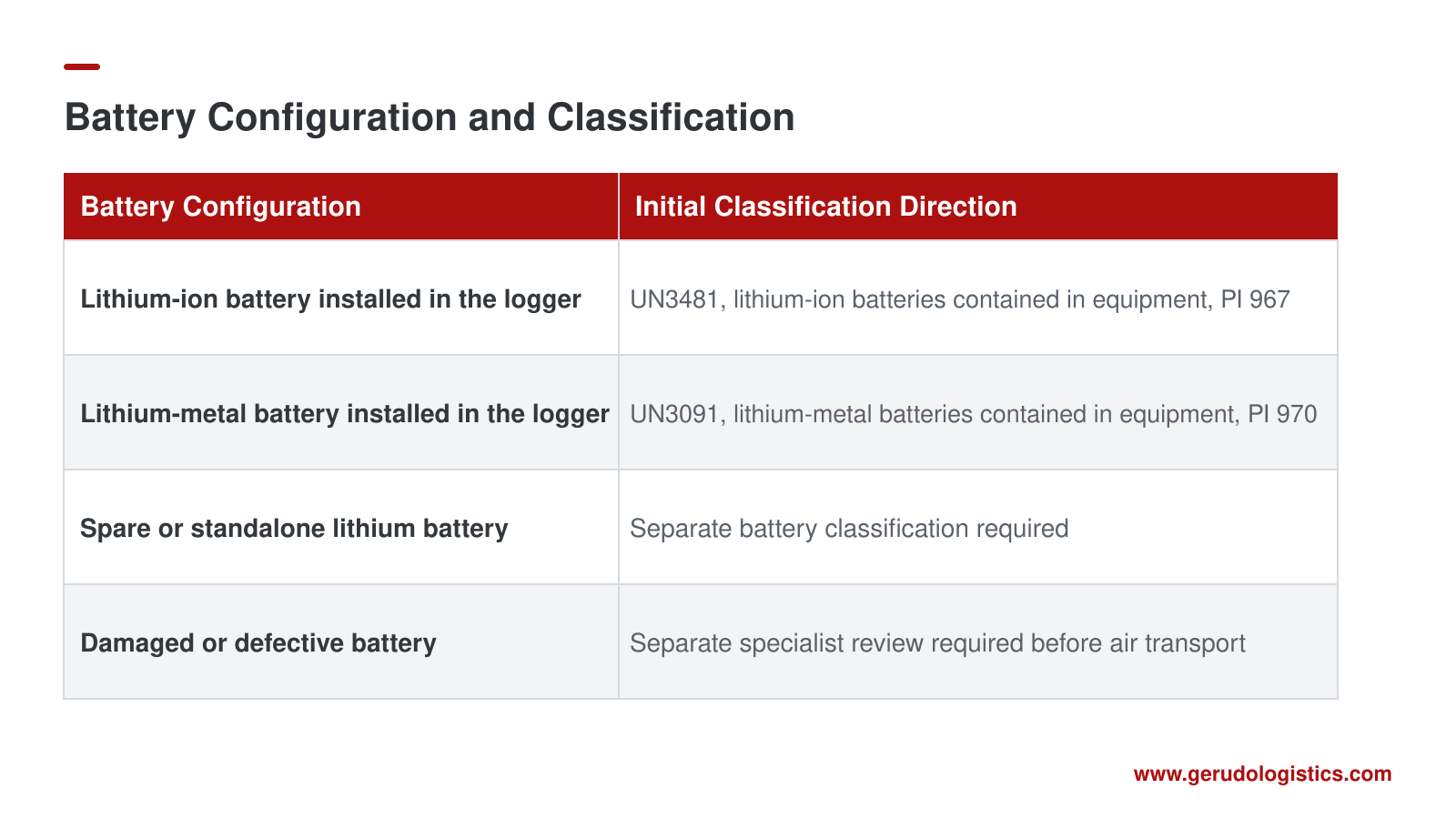
An installed battery remains contained in equipment when the logger is switched off. The power state changes the active-monitoring analysis, while the physical battery configuration remains the same.
A spare battery packed beside the device is not contained in equipment. The importer and supplier must identify loose batteries separately so the freight forwarder can determine the relevant UN number, packing instruction and airline restrictions.
Returned loggers need an additional condition check. A device with a swollen battery, heat damage, leakage or a manufacturer-identified safety defect cannot be assessed as ordinary new equipment.
Requirements Under PI 967 or PI 970
Packing Instruction 967 covers lithium-ion batteries contained in equipment under UN3481. Packing Instruction 970 covers lithium-metal batteries contained in equipment under UN3091.
The applicable section of the packing instruction determines the packaging, marks, labels and documents. Some smaller batteries contained in equipment can use excepted provisions, subject to their conditions and package limits. Other configurations can require fully regulated dangerous goods preparation.
The words "data logger" do not decide whether the package needs a lithium battery mark, Class 9 label or Shipper's Declaration. The battery specifications, number of devices, package configuration and applicable section determine those requirements.
This is why product information needs to reach the freight forwarder before the cargo arrives at the airport. A classification change at that stage can require revised packaging, labels, documents or airline acceptance.
Airline Acceptance for Active Data Loggers
The IATA exception determines the device's regulatory status. Airline acceptance remains a separate decision because each operator can apply its own device disclosure and operating conditions.
The importer and forwarder need to separate three questions:
Does the device meet the monitoring-device exception?
Do its battery safety and electromagnetic performance support active use on board?
Does every operating airline accept the exact model and operating mode?
IATA's Air Cargo Device Assessment supports a more standardized technical evaluation of tracking devices. Airlines can still maintain their own accepted-device lists, submission procedures and restrictions.
Exact Model and Operating Mode
"Temperature logger" is insufficient identification for an airline review. Acceptance can depend on the manufacturer, exact model, battery type, firmware and communication functions. For example, a passive USB recorder and a cellular tracker require different reviews, and two models from the same manufacturer can receive different decisions when their batteries or transmitters differ.
Recording and transmitting are separate functions. A basic USB logger may record data locally without sending it during the flight, while a connected tracker can switch between local storage and transmission according to network availability or its programmed mode.
The airline therefore needs an accurate description of local recording, transmission method, flight mode and power behavior. The manufacturer supplies this information, and the freight forwarder uses it to obtain an airline decision.
If the supplier replaces the approved device after the shipment has been arranged, the freight forwarder needs the new technical information. The review should also identify the flight-mode setting or firmware version where it changes transmitter behavior. An earlier decision for another model or operating configuration cannot be carried over without confirmation.
Direct and Interline Flights
A direct flight and an interline itinerary can produce different acceptance results. Approval by the first airline does not cover a second operating carrier on a connecting route.
The forwarder should check every carrier shown in the planned routing. A change of airline, transfer point or aircraft operator can require the device acceptance check to be repeated.
This matters when the shipment is time-sensitive or temperature-controlled. Discovering an unapproved device at a transfer airport can complicate the movement even when the first flight accepted it.
Documents for Air Freight from China with Data Logger
Documents to Collect from the Supplier
The phrase "data logger included" is not enough for classification or airline review. Importers need the exact device information while the cargo is still with the supplier in China:
Manufacturer and exact model: The identification used for airline review.
Battery chemistry: Lithium-ion or lithium-metal.
Battery parameters: Nominal voltage, capacity, Watt-hour rating or lithium content.
UN 38.3 test summary: Matching the actual cell or battery type.
Installation status: Confirmation that the battery is installed in the logger.
Operating mode: Confirmation of whether the device will remain active.
Communication functions: Cellular, Bluetooth, Wi-Fi, satellite or other transmitting capability.
Device quantity: Number per package, overpack or unit load device.
Aircraft-use information: Available evidence covering electromagnetic compatibility and device safety.
A generic brochure can be inadequate when it covers several models or alternative batteries. The documents must identify the configuration that will physically travel with the shipment. The logger model and battery part number should match across the product data, UN 38.3 test summary and packing list. The supplier needs to resolve any discrepancy before the device is submitted for airline review.
Six Checks Before Departure from China
The shipment review follows six steps:
The importer confirms whether the logger monitors the consignment or travels as the commercial cargo.
The supplier provides the battery chemistry, energy rating and relevant lithium content.
The importer or freight forwarder matches the UN 38.3 test summary to the installed battery.
The freight forwarder submits the exact model, quantity and operating mode to the planned airline.
The freight forwarder confirms acceptance with every operating carrier on the route.
The supplier or packing facility installs and activates the approved logger after the shipment configuration is settled.
Some airlines require the device model and battery type in the handling information on the air waybill. The selected airline's instructions determine the final wording, so the model name should not be added from a generic template. After the shipment configuration is confirmed, the supplier or packing facility can install the approved logger. The importer should retain a shipment record showing the model, serial number, installation position and activation time.
These details connect the recorded data to the correct package at destination or during a cargo claim. For a multi-package shipment, the record should match each logger serial number to its package or pallet. A calibration certificate supports the readings but does not prove battery compliance or airline acceptance.
The monitoring-device exception applies only to the installed battery inside the qualifying logger. It does not change the regulatory or temperature-control status of the main cargo. Medical products still need a suitable temperature-controlled shipping plan from China, including the required storage range and packaging, while other regulated cargo retains its own classification and documents.
The same separation applies when shipping cargo with dry ice from China. A qualifying logger does not remove the UN1845 packaging, marking, quantity or carrier requirements created by dry ice. Temperature data can support a quality review or cargo claim, but it cannot replace the documents required for the goods being monitored.
Gerudo Logistics for Temperature-Controlled Air Freight from China
Gerudo Logistics specializes in dangerous goods and cold-chain shipping from China. This combined experience supports sensitive air cargo that includes dry ice, temperature-controlled packaging or battery-powered monitoring devices.
Importers can work with one logistics partner for transport compliance and temperature-control planning across international shipments from China.
Frequently Asked Questions
Is a Data Logger Still Active If It Records Data but Does Not Transmit It?
Yes. A logger can be active because it records shipment data locally; transmitting that data in real time is a separate function.
Can More Than One Data Logger Be Used in the Same Package or Overpack?
Yes, when the number is genuinely required to monitor the specific consignment. Unrelated, spare or excessive devices do not qualify merely because they travel in the same package.
Can Spare Lithium Batteries Travel With an Active Data Logger?
Spare batteries do not fall within the exception for the battery installed in the logger. They need a separate classification and packing assessment.
Does a Calibration Certificate Prove Air Freight Acceptance?
No. Calibration confirms measurement performance; it does not prove battery compliance, electromagnetic compatibility or airline acceptance.
Must the Data Logger Model Appear on the Air Waybill?
This depends on the carrier. Some airlines require the model and battery type in the air waybill handling information, while others collect the details through a separate procedure.
Does One Airline Approval Cover an Interline Flight?
Every operating carrier on a connecting itinerary must accept the device and its operating mode. Approval from the first airline does not cover the remaining carriers automatically.
What Happens If the Data Logger Model Changes After Airline Review?
The replacement model needs to be checked before installation. Approval for another model from the same manufacturer cannot be assumed to apply.