Re-export Frozen Goods Through China: Reefer Transit and Bonded Cold Storage
A frozen shipment moving through China has two systems that must remain aligned: customs supervision and the cold chain.
Once the inbound reefer reaches a Chinese port, the cargo can stay sealed inside the original container, move into bonded cold storage, or be reloaded into another reefer for the onward shipment. Each route creates a different combination of equipment, handling, temperature and document requirements.
This guide is for importers who have already decided to route frozen or chilled goods through China. It explains how to choose the China transit arrangement, when the original reefer can continue, what changes after unloading, and how to coordinate the onward refrigerated shipment.
At a glance: keeping frozen cargo sealed inside its original reefer normally creates the fewest cold-chain handovers. If the goods need storage, splitting or reloading, the customs arrangement and bonded cold-storage facility must support the planned handling. For food cargo, confirm that health, veterinary, phytosanitary or other destination documents will still support the final shipment before the original container is opened.
How Frozen Goods Move Through China Under Bonded Transit
Frozen cargo can follow different physical routes while remaining under customs supervision in China. The main difference is what needs to happen to the goods between arrival and the onward sailing.
Direct reefer transshipment means the frozen goods remain sealed inside the refrigerated container while the container connects to its onward service in China. The reefer can change vessels while the cartons, pallets and original load remain untouched.
Bonded cold storage means the goods are unloaded from the reefer and placed into an approved temperature-controlled facility under the applicable bonded arrangement. The cargo remains there until the onward shipment is ready.
A third arrangement combines bonded storage with splitting or reloading. The inbound reefer is unloaded, some or all of the cargo stays in storage, and the goods are later placed into one or more outbound reefers.
These arrangements create different transport records. A sealed reefer keeps the cargo, container and seal together throughout the connection. Once the cargo enters a warehouse, bonded inventory records become the link between the inbound shipment and the goods that later leave China.
Customs permission also determines what can physically happen to the cargo. Under China's transit rules, goods remain under customs supervision from entry to departure. Transit food and certain animal, plant and other quarantine-controlled products cannot be opened or unloaded without the required customs approval.
The China-side movement therefore needs to be confirmed before arrival, particularly when the plan includes opening the reefer.
Should the Cargo Stay in the Reefer or Move Into Bonded Cold Storage?
This is the main operational decision after the China route has been selected. The answer depends on what must happen before the cargo leaves China again.
Keeping the original reefer is generally suitable when the cargo moves through China as one intact shipment. Bonded cold storage becomes relevant when the goods need more time, different equipment or physical handling.
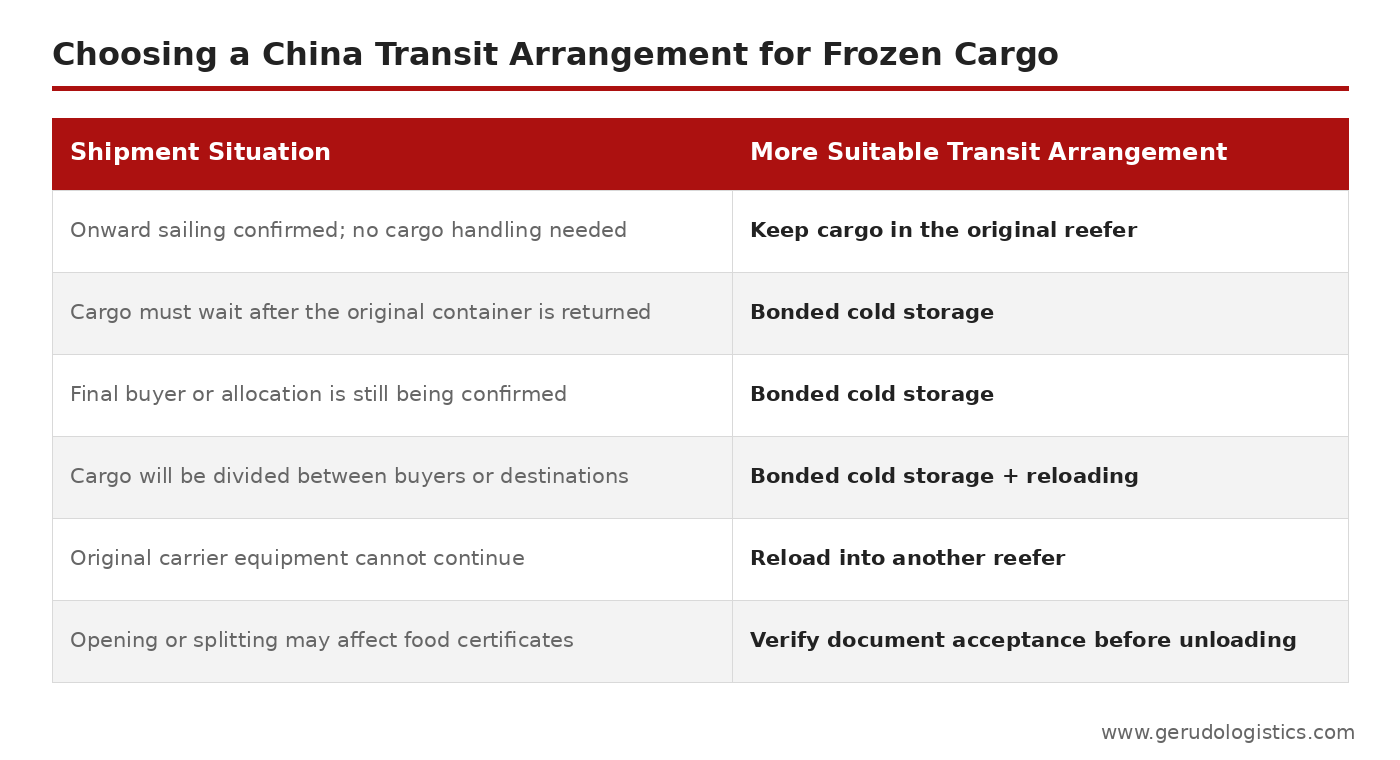
The table gives the initial direction. Carrier acceptance, customs approval, cold-store capability and destination document requirements still need to support the selected arrangement.
Keep the Cargo in the Original Reefer
Keeping the cargo sealed usually works best when the onward movement has already been organized.
This arrangement is more suitable when:
The final destination is confirmed.
The onward vessel connection is available.
The shipment remains intact.
No warehouse handling is planned.
The carrier accepts the China connection.
The reefer remains assigned to the onward movement.
The container is discharged from the inbound vessel, remains under the applicable customs and terminal arrangements, and is loaded onto the connecting service without opening the doors.
This keeps the number of physical cargo handovers low. The main requirement is ensuring that the equipment arrangement supports the intended journey.
A through booking or accepted carrier transshipment arrangement allows the original container to continue when the carrier keeps that equipment assigned to the shipment. A separate onward booking or carrier change creates a different equipment arrangement.
In our experience, container continuity should be confirmed early. Importers sometimes plan around the assumption that the reefer will remain available through China, while the carrier requires the original equipment to be returned before the next leg.
This becomes more important when the connection involves a longer wait. Reefer containers are transport equipment, and keeping carrier-owned equipment at the terminal for an extended period can add power, demurrage or equipment-related costs. The different charging mechanisms are explained further in our guide to demurrage and detention fees for reefer containers.
Move the Cargo Into Bonded Cold Storage
Bonded cold storage is the practical alternative when the cargo needs time or handling in China before the onward shipment.
Common situations include:
The next sailing occurs much later.
The buyer has not confirmed the release schedule.
The original reefer needs to be returned.
The cargo will be divided between onward shipments.
Another reefer will be used for the next leg.
Permitted warehouse handling is required.
Opening the container changes the shipment from a container-based movement into a warehouse-based movement. The bonded facility receives the goods, records the inventory, maintains the required temperature and later releases the cargo for onward loading.
The selected facility must match both the commodity and the planned operation. A general bonded warehouse may have no frozen capacity, while a cold-storage facility can have restrictions on specific meat, seafood or agricultural products.
Before arrival, confirm:
Customs status of the facility
Accepted commodity
Required storage temperature
Available cold-room capacity
Permission for the intended handling
Inventory traceability
Loading and unloading arrangements
Access for the outbound reefer
Chinese Customs identifies five types of simple processing for bonded warehouse goods: packaging, grading or classification, marking, splitting and assembly. Substantial processing falls outside this scope.
Splitting is particularly relevant to frozen cargo moving through China. One inbound load can be allocated into several onward shipments when the customs arrangement, facility capability and product controls support the planned operation.
The customs storage period is also different from the practical cold-chain storage plan. Bonded warehouse goods have a general storage period of one year. Where there is a justified reason and Customs agrees, an extension can be approved, normally for no more than another year.
This is a customs storage limit rather than a recommended storage period for frozen goods. The actual period still depends on warehouse acceptance, product condition, commercial requirements and the onward transport plan.
Confirm Food Documents Before Unloading
For frozen food, destination document acceptance needs to be checked before the reefer is opened.
Depending on the product and final market, the shipment may rely on:
Health certificates
Veterinary certificates
Phytosanitary certificates
Catch certificates
Production or establishment records
Country-of-origin documents
Official food documents can refer to the container number, seal, quantity, consignee, establishment or final destination.
If the cargo is divided, transferred into a different reefer or allocated to another buyer, the structure of the onward shipment changes. The importer needs to confirm whether the original certificates still support that movement.
This check belongs before unloading because a document problem discovered after the cargo has already been divided can be much harder to correct than the physical transit plan.
Where Cold-Chain Risk Changes During China Transit
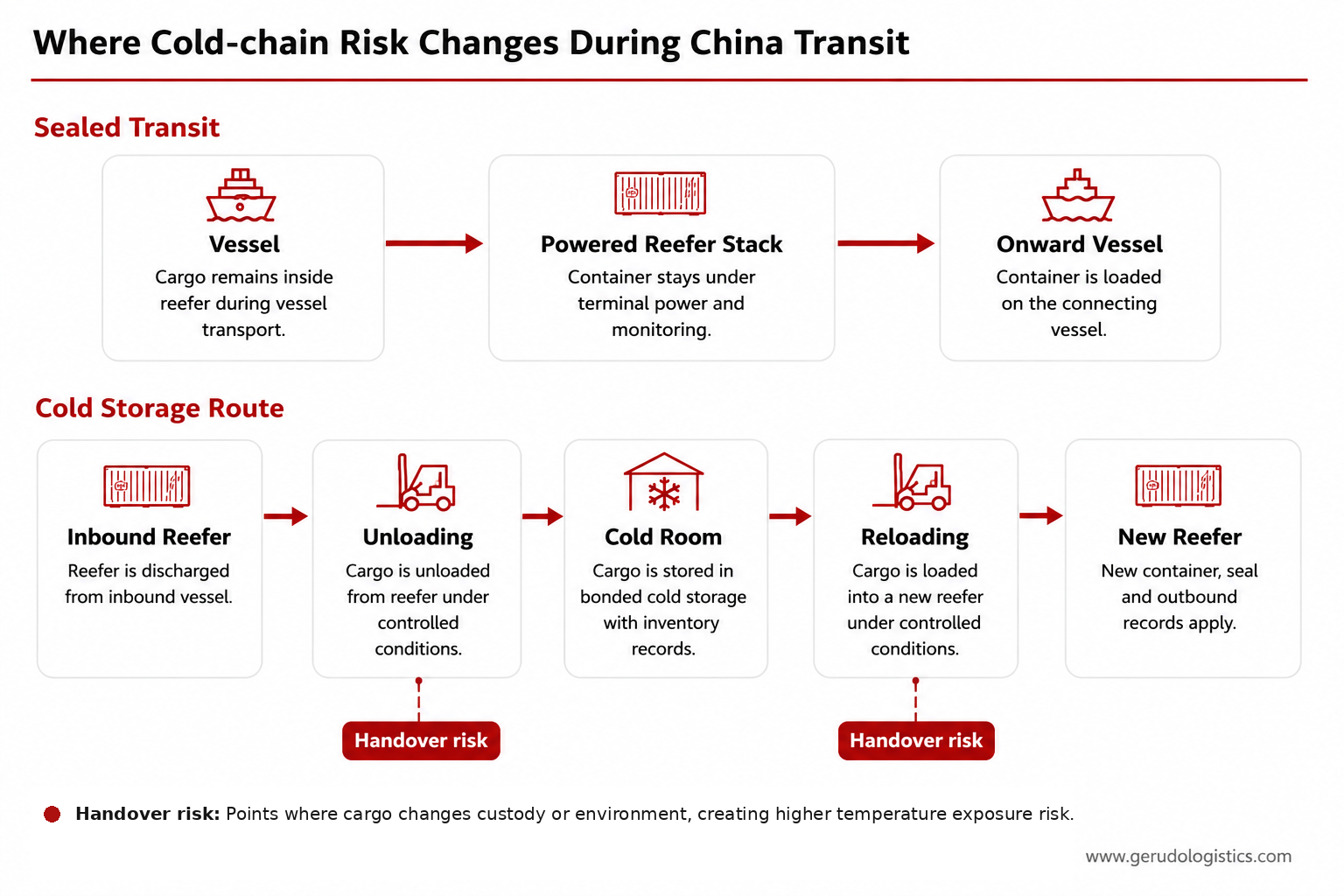
After the route has been selected, the key cold-chain question becomes where the cargo changes environment or custody.
A sealed reefer movement has fewer handovers. A cold-storage route adds unloading and reloading stages where the cargo moves between separate temperature-controlled environments.
While the Reefer Waits for the Connection
For sealed transit, the frozen goods remain inside the same refrigerated environment. The main transition points occur around vessel discharge, terminal storage and loading onto the connecting vessel.
The reefer needs the appropriate terminal power and monitoring arrangement during the waiting period. Operating records can show temperature history, equipment status and off-power periods if the connection is delayed or cargo condition is questioned later.
A reefer's air-temperature reading and the temperature inside the product are different measurements. Cargo mass, packaging, airflow and the length of an interruption influence how quickly the actual goods respond to changing conditions.
The objective during sealed transit is to maintain continuity through each transport transfer while keeping the container closed.
For more detail on reefer operation, set points and temperature monitoring, our reefer container shipping guide covers the equipment side of refrigerated ocean freight.
From the Reefer Into Cold Storage
Opening the container moves the main cold-chain exposure to the reefer-to-warehouse handover.
The physical sequence is:
reefer opening → unloading → warehouse receiving → cold-room storage
The required cargo temperature needs to be agreed with the cold store before unloading begins. The warehouse can then receive the goods against the planned temperature and shipment details.
Useful receiving information includes:
Arrival temperature
Unloading start and completion time
Cargo quantity
Lot or batch details
Visible cargo condition
Assigned storage location
These records establish the handover between the inbound reefer and the bonded cold store.
Once the goods are inside the correct temperature-controlled room, the storage phase is more stable. The more sensitive period is the movement between the container and that storage environment.
From Cold Storage Into the Next Reefer
Cold storage protects the cargo while it waits. Reloading creates the next major handover because the goods leave the warehouse environment and enter a new transport unit.
The physical sequence is:
cold-room release → loading area → reefer loading → doors closed → new seal → onward movement
The outbound reefer needs to be prepared for the required transport temperature before the cargo is loaded. Frozen goods should already be at their required shipping condition because reefer equipment is designed primarily to maintain temperature during transport.
The loading window also matters. Cargo held outside controlled storage for longer than planned experiences a different environment from cargo remaining inside the cold room.
For sensitive or higher-value shipments, an independent cargo data logger can provide another temperature record alongside the reefer operating data and warehouse records.
What Changes When Frozen Cargo Is Unloaded in China?
Unloading creates a new inventory and custody chain between the inbound and outbound movement.
With sealed transit, the same container, seal and cargo remain together. Once the goods enter bonded cold storage, warehouse inventory becomes the link between the goods that arrived and the cargo that later leaves China.
Cargo Identity Must Remain Traceable
The cold store needs enough information to identify the bonded cargo throughout receiving, storage and release.
Typical records include:
Product description
Package or pallet quantity
Gross and net weight
Lot or batch number
Country of origin
Quantity received
Quantity released
Outbound container number
Outbound seal number
These records become particularly important when one inbound reefer is split into several onward shipments.
For example, if 2,000 cartons enter bonded cold storage and 800 cartons are released into the first outbound reefer, the records need to account for the released quantity and the remaining 1,200 cartons.
Splitting is one of the five simple processing activities specifically identified for bonded warehouse goods. The facility and customs arrangement still need to support the particular operation.
Reloading Creates New Transport References
Once the frozen goods enter another container, the outbound reefer becomes a new transport reference.
The new container and seal numbers need to align with the warehouse release, onward booking and customs records. If the original cargo has been split, each resulting shipment also needs the correct quantity.
Storage, splitting and reloading in China do not by themselves change the foreign origin of the goods. The original origin evidence therefore continues to support the onward cargo where the final destination applies country-specific tariffs, veterinary controls, sanitary requirements or other product rules.
This is particularly important for frozen meat and seafood because the final market can also link eligibility to the country and establishment where the food was produced.
Food Certificates Must Support the Final Shipment
The food-document check made before unloading needs to be reviewed again against the actual outbound load.
If the cargo remains intact and only changes containers, the key issue can be whether the destination authority accepts the changed container or seal information.
If the original load has been divided, the shipment structure becomes more complex. One original certificate may refer to a quantity, seal or consignee that no longer matches each resulting shipment.
Depending on the product and final market, confirm:
Whether the original certificate remains acceptable
Whether amendment or replacement is available
Whether the new seal needs to be reflected
Whether shipment splitting is accepted
Whether transit or storage evidence is required
There is no single certificate rule that applies to every frozen-food destination. The check needs to be made against the actual commodity, origin, certificate and final market.
How to Arrange the Onward Reefer Shipment
The final China-side task is to align reefer equipment, bonded release, warehouse loading and vessel cut-off.
For cargo remaining inside the original reefer, the main priority is the vessel connection. A schedule change extends terminal dwell time and can increase reefer power and equipment costs.
Cargo stored in bonded cold storage creates more moving parts. The outbound reefer needs to become available, the warehouse needs a loading slot, the cargo needs the applicable release, and the loaded container still has to reach the terminal before cut-off.
These events need to be planned around the same sailing.
In our experience, booking the onward vessel without coordinating warehouse release and reefer availability creates avoidable delays. The cold store can be ready before the container arrives, or the reefer can be available while the cargo is still waiting for release.
Before loading the onward reefer, confirm:
Final destination
Consignee
Final cargo quantity
Required transport temperature
Reefer size
Carrier and sailing
Warehouse release timing
Customs arrangement
Food and origin documents
Terminal cut-off
If the original cargo has been divided, check each outbound shipment separately. The quantity and certificates that supported the inbound reefer should not simply be assumed to cover every resulting load.
The final market's requirements continue to depend on the actual commodity and its country of origin. Passing through a bonded facility in China does not replace the food, veterinary, phytosanitary or customs requirements applied at the destination.
Importers planning the final entry can find the main destination-side document and clearance considerations in our guide to customs clearance for reefer containers.
A controlled onward movement keeps three records aligned:
physical cargo → bonded inventory → cold-chain history
When the shipment structure changes in China, all three need to describe the same final cargo movement.
Temperature-Controlled Shipping With Gerudo Logistics
Gerudo Logistics specializes in temperature-controlled shipping from China, supporting frozen, chilled and other temperature-sensitive cargo across major international markets.
Our strength lies in combining cold-chain expertise, customs coordination and international freight planning under one logistics arrangement. With operations across major Chinese ports, Gerudo Logistics can design suitable shipping solutions based on cargo type, temperature requirements, destination and delivery priorities.
Contact us to discuss your temperature-controlled shipment from China.
Frequently Asked Questions
Does Frozen Cargo Always Need Bonded Cold Storage When Moving Through China?
No. Frozen cargo can remain inside its original reefer when the onward connection, carrier arrangement, customs procedure and product requirements support a sealed transit movement.
Can Frozen Meat or Seafood Be Unloaded in China?
Yes, when the applicable customs and quarantine arrangement permits it. The selected cold-storage facility must also accept the commodity, and the final destination documents need to support the planned handling.
Can the Same Reefer Continue to the Final Destination?
Yes, if the carrier and onward booking keep the same equipment assigned to the shipment. A different reefer is needed when the original equipment must be returned before a separate onward movement.
Can Frozen Goods Stay in a Bonded Warehouse for One Year?
Yes. Chinese Customs sets the general bonded warehouse storage period at one year. An extension can be approved where there is a justified reason, while the practical storage period still depends on the cold store and cargo.
What Processing Can Be Done in a Bonded Warehouse?
Chinese Customs identifies five types of simple processing: packaging, grading or classification, marking, splitting and assembly. The operation still needs to fit the applicable customs arrangement and the capabilities of the selected facility.
Can One Inbound Reefer Be Split Into Several Onward Shipments?
Yes, where the bonded facility and customs arrangement support the planned split. Each resulting quantity needs to remain traceable to the original bonded inventory, and the food documents need to support the new shipment structure.
What Should Be Confirmed Before Opening the Original Reefer?
Confirm customs permission, cold-store acceptance, temperature requirements and final-destination document validity first. For food cargo, pay particular attention to certificates linked to the original container, seal, quantity or consignee.