How to Import and Ship Auto Parts from China
Auto parts from China can move by express, air freight, LCL, or FCL. Express suits samples and urgent spare parts, air freight suits time-critical commercial orders, LCL suits smaller palletised shipments, and FCL suits heavy, bulky, or high-volume cargo.
The correct method depends on final packed weight, cargo dimensions, delivery urgency, damage exposure, and whether the parts contain batteries, liquids, pressure devices, or pyrotechnic components.
Best Shipping Methods for Auto Parts from China
The best shipping method depends on shipment size and urgency. The comparison below gives importers a practical starting point before requesting a route-specific quotation.
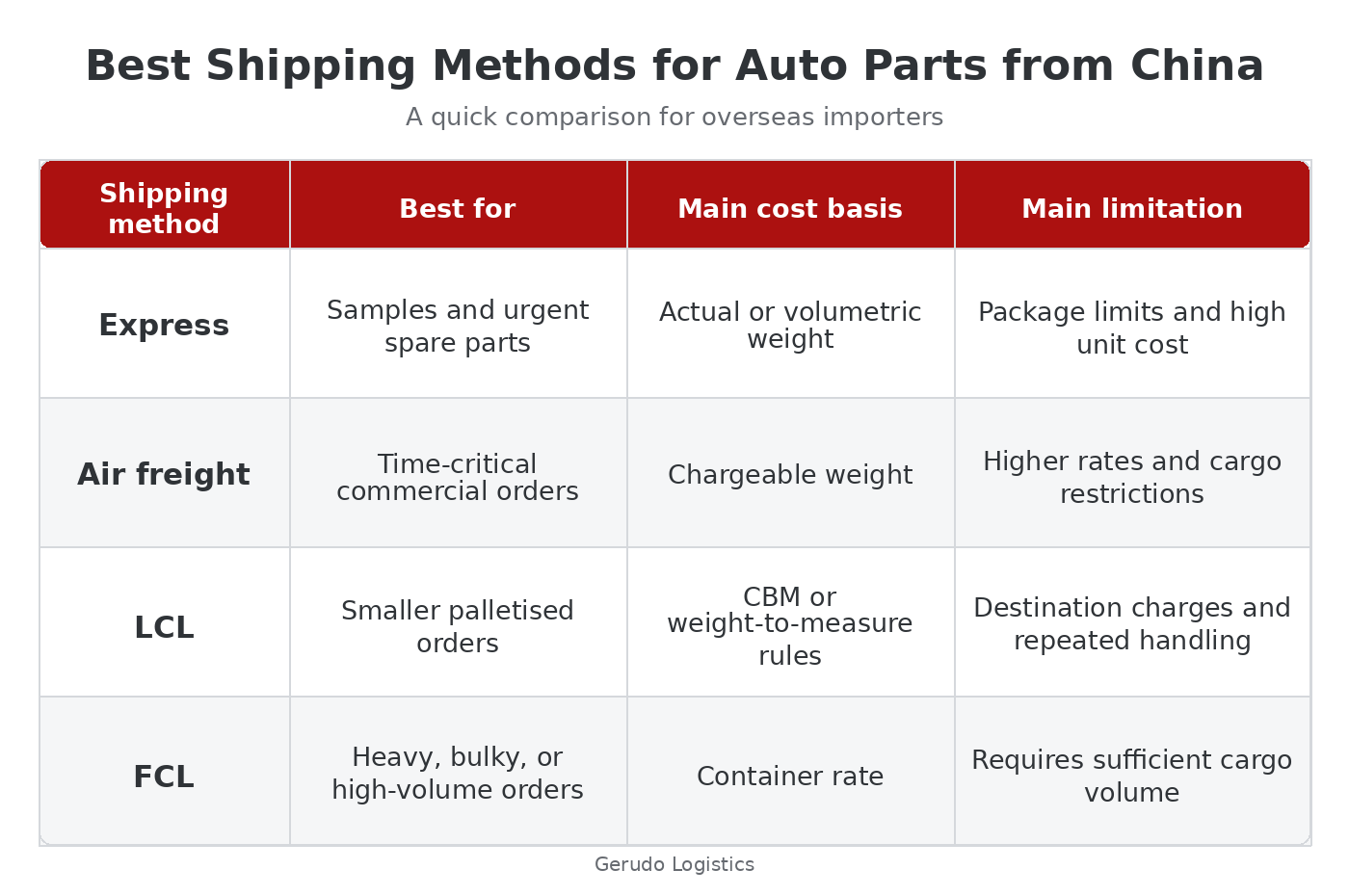
Express Shipping for Small and Urgent Parts
Express is commonly used for sensors, control units, samples, and small replacement parts. It usually includes collection, international transport, customs processing, and door delivery.
Commercial shipments still need an accurate invoice, product description, HS code, and importer information. Express networks also apply package weight and size limits, so long body parts, dense metal components, and irregular crates may be rejected or charged at a higher rate.
Free-shipping offers should be checked against the Incoterm and delivery scope. Import duty, tax, customs clearance, remote-area fees, and local delivery may remain payable.
Air Freight for Time-Critical Orders
Air freight is suitable for urgent production parts, higher-value components, and commercial orders that cannot wait for sea freight.
Charges are based on actual or volumetric weight, whichever is higher. Dense brake components normally charge by actual weight, while bumpers and body panels can produce a much higher volumetric weight.
Importers should confirm whether the quotation includes supplier pickup, origin handling, customs clearance, destination handling, and final delivery. Batteries, airbags, magnets, liquids, and pressurised parts must be disclosed before the route is selected because airline acceptance varies by airport and carrier.
LCL Shipping for Palletised Orders
LCL allows an importer to use part of a shared container. It is commonly used for palletised brake parts, suspension components, mixed spare parts, and orders that are too large for air freight.
Charges are generally based on volume, subject to minimum charges and weight-to-measure rules. Dense pallets can also require additional warehouse handling.
LCL cargo passes through consolidation and deconsolidation facilities, so every package must withstand repeated lifting and movement. The ocean freight component alone does not represent the total cost. Importers should also confirm China pickup, origin warehouse fees, destination terminal charges, customs clearance, and final delivery.
For US-bound orders, our guide to FCL vs LCL shipping from China to the USA explains the cost and transit differences in more detail.
FCL Shipping for Heavy or Bulky Orders
FCL gives one importer the use of a complete container. It is commonly selected for bulky body parts, heavy mechanical components, engines, large aftermarket orders, or cargo collected from several suppliers.
A 20-foot container often suits dense products because its payload may be reached before the internal space is full. A 40-foot or 40-foot high-cube container provides more volume for bumpers, panels, plastic parts, and other low-density cargo.
Container planning should cover total cargo weight, floor pressure, weight distribution, blocking and bracing, loading sequence, and the unloading method at destination. FCL reduces repeated handling, but its cost advantage depends on route, season, equipment availability, and container utilisation.
What Types of Auto Parts Are Commonly Shipped from China?
The type of auto part affects chargeable weight, packaging, carrier acceptance, and documentation. Heavy metal parts create weight and handling issues, body parts create volume and damage risks, while batteries, airbags, and fluid-containing components may require specialist approval.
Heavy Mechanical Parts
Brake discs, wheel hubs, bearings, gears, suspension components, steering parts, shafts, fasteners, and machined metal parts are compact but dense. A small pallet can weigh several hundred kilograms, affecting pallet strength, forklift handling, inland transport, and container weight distribution.
For machined parts, provide accurate materials, dimensions, unit weights, and product descriptions. Quality should be assessed through drawings, tolerances, material specifications, samples, and inspection criteria rather than country of manufacture alone.
Bulky Auto Body Parts
Bumpers, doors, bonnets, fenders, grilles, mirrors, lighting assemblies, plastic trim, and sheet-metal panels often create high volumetric charges despite moderate actual weight.
Their main transport risks are scratching, crushing, edge impact, internal movement, and poor stackability. Freight quotations should use final packed dimensions because the unpacked product does not show the actual chargeable volume.
Electronic Parts With Batteries
Sensors, electronic control units, cameras, displays, lighting systems, and control modules are usually smaller and higher in value than mechanical parts.
Confirm whether the product contains a lithium cell, backup battery, wireless transmitter, or magnet. A complete EV battery pack requires a different review from a control unit containing a small cell.
Depending on the product and transport method, the forwarder may request a UN 38.3 test summary, battery specifications, an SDS, and dangerous goods documents. See our guide toshipping batteries and battery products from China.
Parts Requiring Carrier Approval
Engines, gearboxes, compressors, hydraulic components, and shock absorbers may contain fuel, oil, coolant, refrigerant, or pressurised material. The supplier should confirm the condition of the part and provide photos showing drainage, sealed openings, and any visible leakage.
Airbag modules, inflators, gas generators, and seat belt pretensioners can contain pyrotechnic devices. Many are classified as UN3268, Class 9, subject to their design and supporting documentation.
Carrier approval may depend on classification, packaging, labels, declarations, and route availability. Our guide to shipping airbags and automotive safety devices from China explains these requirements in detail.
How Auto Parts Should Be Packed for International Shipping
Packaging must protect the product, support safe handling, and meet carrier and destination requirements. The design should reflect the part's weight, shape, surface finish, orientation, and internal contents.
Securing Heavy Parts
Brake discs, hubs, gears, engines, and gearboxes should be placed on pallets, skids, or inside crates rated for the actual cargo weight.
Dense cargo generally needs a reinforced base, secure anchoring, balanced loading, clear forklift access, and visible gross-weight labels. Cartons should not serve as the primary load-bearing structure for heavy or irregular metal parts.
Protecting Body Parts
Body panels, doors, lights, mirrors, grilles, and painted components need protection against abrasion, impact, crushing, and deformation.
Protective film, foam, separators, corner reinforcement, and a rigid outer carton or frame can protect the surface and maintain the product shape. Non-stackable packages should be identified before quotation because they can increase air freight volume and reduce container utilisation.
Preparing Parts With Fluid Residue
Engines, gearboxes, pumps, compressors, and hydraulic parts should be checked for fuel, oil, coolant, and other fluids before collection.
The carrier may request drainage, cleaning, photos, or a supplier statement. Packaging may require a sealed base, absorbent material, stable mounting, and capped openings. Visible leakage or unclear fluid status can cause rejection at the warehouse, airport, port, or consolidation facility.
Meeting ISPM 15 Requirements
Solid wood pallets, crates, and dunnage used in international transport are generally expected to comply with ISPM 15. The treatment mark should be visible and legible.
Plywood and other processed wood materials may be treated differently from solid wood under plant-health rules. Confirm the final packaging material against the destination requirement.
Documents Needed to Ship and Import Auto Parts from China
Most shipments require a commercial invoice, packing list, transport document, accurate product description, and country-of-origin information. Regulated components can require additional carrier and safety documents.
Documents for Customs Clearance
The commercial invoice should show the product description, part number, quantity, value, currency, buyer, seller, and Incoterm. The packing list should show package count, net weight, gross weight, dimensions, and packing method.
Descriptions such as spare parts or accessories may be too broad. A description such as steel brake discs for passenger vehicles gives the customs broker a clearer basis for classification.
Cargo Details Needed Before Booking
Provide the product name, part number, package count, gross weight, final packed dimensions, packing material, pickup address, ready date, and package photos.
The supplier should also disclose batteries, liquids, gases, magnets, pressure devices, refrigerants, and pyrotechnic components. Estimated product dimensions cannot replace final packing data because packaging can materially change the chargeable volume and handling method.
Documents for Regulated Parts
Depending on the cargo, the file may require a UN 38.3 test summary, SDS, battery specification, dangerous goods declaration, classification evidence, drainage statement, or carrier approval form.
There is no universal certificate covering every auto part. A bumper, brake hose, control unit, battery module, and airbag can each require different supporting records.
How Much Does It Cost to Ship Auto Parts from China?
Shipping cost depends mainly on packed weight, cargo volume, transport method, supplier locations, packaging, regulated content, and destination charges.
A practical landed-cost calculation includes:
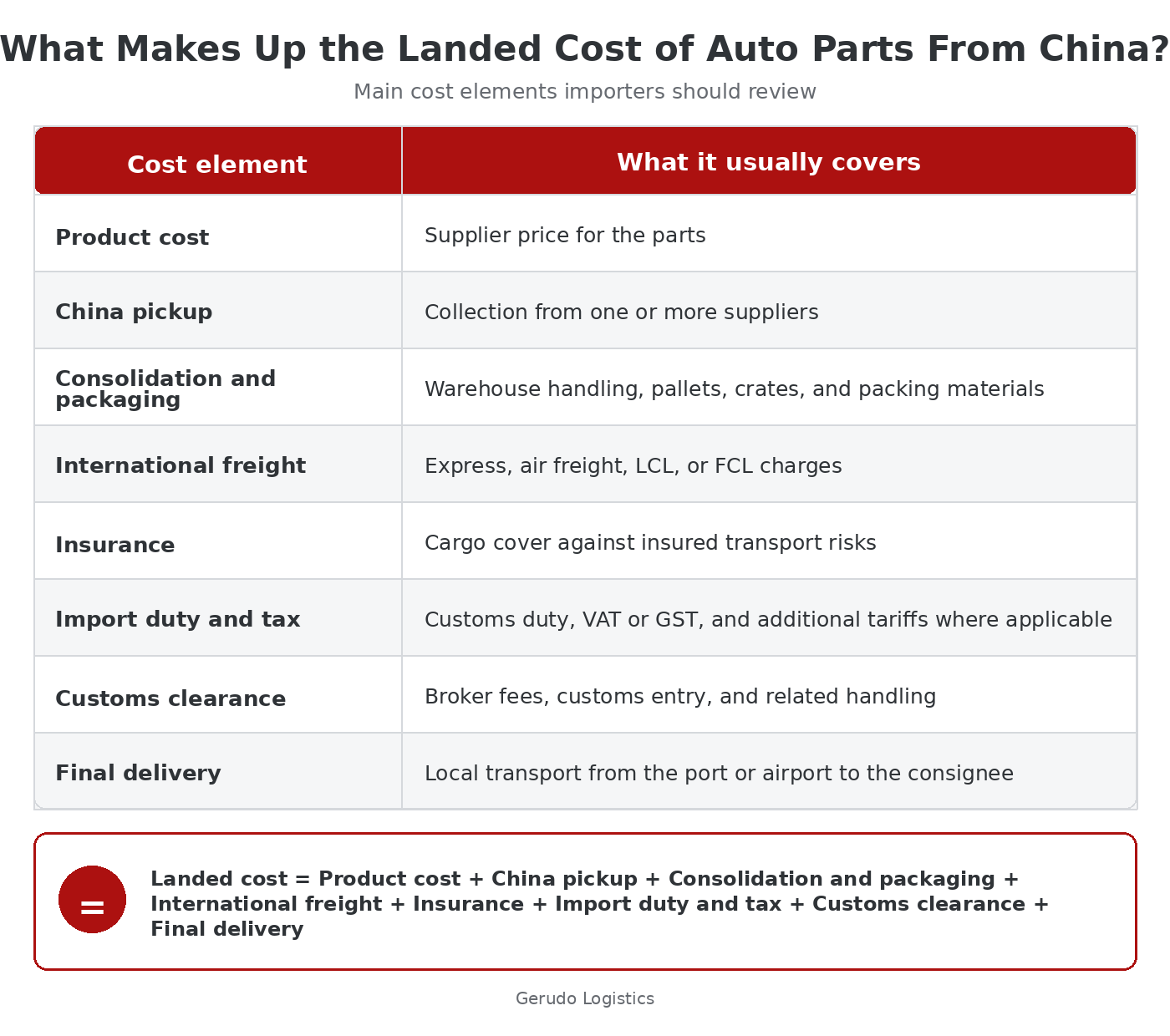
Heavy mechanical parts are driven by actual weight, while body panels are often driven by volume. Custom crates, multiple supplier pickups, dangerous goods handling, LCL terminal charges, and final delivery can materially affect the total.
Use final packed cargo data and a defined service scope when comparing quotations. The lowest freight rate does not necessarily produce the lowest landed cost. For a more detailed calculation, see our guide to landed cost for a China-USA shipment.
Import Duties and Tariffs on Auto Parts from China
Import duty depends on the destination-country tariff code, origin, customs value, product function, and applicable trade measures.
Many vehicle parts fall under HS heading 8708. Engines, tyres, batteries, glass, lighting equipment, and electronic devices may be classified under other headings.
Why the HS Code Determines the Duty
A supplier's six-digit HS code is only an initial reference. The importer should confirm the complete destination-country code with its customs broker.
Classification can depend on product function, material, vehicle application, level of assembly, and whether the part is new or used. The final code determines the normal duty rate and may trigger additional tariffs, trade-defence duties, or import controls.
Our guide on how to find and verify the right HS code explains the difference between the six-digit HS code and destination-specific classifications.
US Tariffs on Chinese Auto Parts
A US importer may need to review normal HTSUS duty, Section 301, Section 232, and applicable antidumping or countervailing duties.
As of July 2026, USTR has extended 178 Section 301 exclusions until November 10, 2026. An exclusion applies only when the product matches the precise tariff provision and product description in the official notice.
A 25 percent Section 232 tariff applies to specified automobile parts under listed tariff provisions. The measure began applying to covered automobile parts on May 3, 2025. It does not apply automatically to every product sold as an auto part.
A normal HTSUS rate of zero does not remove other possible duty layers. The customs broker should review every applicable measure before the landed cost is confirmed.
Routing Chinese-origin parts through Mexico, Canada, or another country does not by itself change origin. A different origin claim requires sufficient processing under the applicable rules and supporting production records.
EU Customs Duty and Import VAT
EU customs duty is determined by the Combined Nomenclature and TARIC code, country of origin, customs value, and applicable tariff measures.
TARIC integrates EU customs duties and commercial measures so they can be applied consistently across Member States.
The landed-tax calculation may include customs duty, import VAT, trade-defence duties, customs representation, terminal charges, examination, and storage. TARIC does not provide national VAT rates, so the importer must confirm the rate and accounting procedure in the Member State of import.
A low or zero customs duty rate can still result in a material import VAT payment. Duty and VAT should be calculated separately.
Importing Used Auto Parts from China
Used auto parts need an additional review because import eligibility, condition, valuation, contamination, and insurance treatment can differ from new parts.
Some destinations restrict used tyres, engines, emissions-related components, safety devices, damaged parts, or goods classified as waste or scrap. Confirm eligibility before purchase.
Used parts should be supported by condition photos, serial numbers, part numbers, inspection reports, and evidence of the transaction value. Used engines and gearboxes should also be checked for residual fluids, dirt, leakage, and sealed openings.
Cargo insurance may exclude pre-existing damage, corrosion, wear, or internal mechanical failure. Pre-shipment records help separate existing defects from transport damage.
How to Import Auto Parts from China Step by Step
The import process should move from product verification to cargo preparation, tariff review, booking, clearance, and final delivery.
Step 1 Confirm the Exact Part
Confirm the product name, part number, material, vehicle application, technical specification, brand status, and condition.
For machined parts, review drawings, tolerances, surface treatment, material requirements, samples, and inspection criteria.
Step 2 Check Destination Requirements
Confirm whether the destination permits the product to be imported and sold. Additional controls may apply to used parts, safety components, batteries, wireless electronics, emissions-related parts, and branded goods.
Step 3 Collect Final Cargo Details
Obtain the package count, gross weight, packed dimensions, packing photos, pickup address, and ready date. Require the supplier to disclose any battery, liquid, gas, magnet, pressure device, refrigerant, or pyrotechnic component.
Step 4 Confirm Carrier Acceptance
Send the cargo description, photos, and regulated content information to the forwarder before collection. Obtain battery records, an SDS, classification evidence, drainage confirmation, or carrier-specific approval where required.
Step 5 Choose the Shipping Method
Compare express, air freight, LCL, and FCL according to the packed cargo data, delivery deadline, damage exposure, and complete destination cost.
Step 6 Approve the Packaging
Confirm that the packaging supports the cargo weight, protects vulnerable surfaces, permits safe lifting, and complies with destination wood-packaging requirements.
Step 7 Verify the HS Code and Taxes
Confirm the destination-country tariff code and estimate normal duty, import VAT or tax, additional tariffs, trade-defence duties, and customs charges.
Step 8 Check the Final Documents
Ensure that the invoice, packing list, labels, technical records, and dangerous goods documents use consistent descriptions, quantities, part numbers, and weights.
Step 9 Arrange Clearance and Delivery
Confirm the importer of record, customs broker, duty payment method, and arrival documents. The delivery location should also confirm appointments, loading-dock access, forklift availability, liftgate service, or crane requirements.
How Gerudo Logistics Supports Auto Parts Shipping from China
Gerudo Logistics provides international freight forwarding services from China for overseas importers. Headquartered in Guangzhou, with operations across Shenzhen, Shanghai, Ningbo, Qingdao, and Dalian, we coordinate supplier pickup, cargo consolidation, air freight, sea freight, customs clearance, and final delivery.
Our team handles general cargo, dangerous goods, and specialist freight under applicable international and local transport regulations. Each route is planned according to the cargo profile, destination, delivery schedule, and required service scope.
Contact Gerudo Logistics to discuss your auto parts shipment from China.
Frequently Asked Questions
Can I Buy Auto Parts Directly From China?
Yes. Confirm compatibility, specifications, trademark status, import eligibility, and final packed cargo data before approving the shipment.
Does Free Shipping Include Import Duty?
Usually, free shipping covers only the delivery scope stated by the seller. Check the Incoterm and confirm whether duty, tax, customs clearance, terminal handling, and final delivery are included.
Are Machined Auto Parts From China Reliable?
Reliability depends on production controls, materials, tolerances, testing, and inspection. Approve drawings, samples, acceptance criteria, and inspection procedures before mass production.
Can Batteries or Airbags Move With Ordinary Parts?
They can be managed under one logistics project, but separate packages, pallets, bookings, or transport units may be required. Classification, segregation, packaging, and carrier acceptance must be reviewed first.
Can Parts From Several Suppliers Be Consolidated?
Yes. Use consistent package labels, part numbers, and supplier records so each consignment can be checked before loading.
Should Auto Parts Be Insured?
Cargo insurance is advisable for high-value, fragile, customised, or difficult-to-replace parts. Confirm the insured risks and exclusions because carrier liability may be limited.
Conclusion
Shipping auto parts from China requires a plan based on the exact component, final packed cargo data, and destination market.
Importers should compare the complete service scope, confirm regulated content, verify tariff classification, and prepare clearance before the cargo departs. This provides a reliable basis for choosing express, air freight, LCL, or FCL.